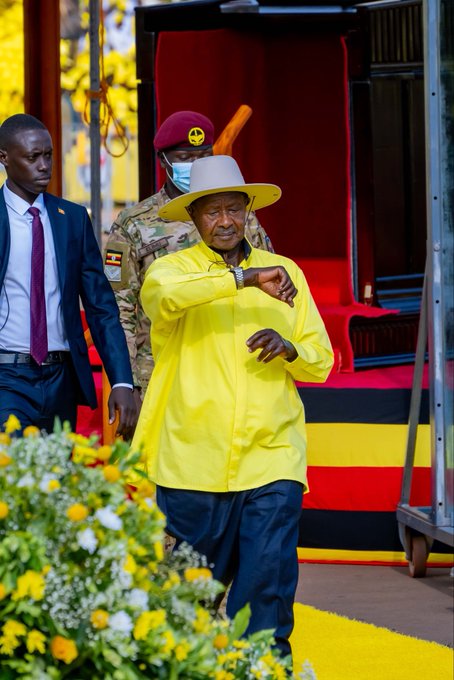
President Yoweri Museveni has called on opposition leaders and their supporters to pursue principled reconciliation following the conclusion of Uganda’s 2026 general elections, urging political actors to set aside confrontation and work towards national cohesion.
In a post-election letter addressed to Ugandans, President Museveni congratulated citizens on the completion of the presidential, parliamentary, local government and LC1 elections, describing the campaign period as largely peaceful and participatory. He said he addressed rallies across the country and noted broad turnout by elders, youth and children, which he described as reflective of continued public engagement in the political process.
The President attributed what he termed Uganda’s relative political stability over the years to reforms undertaken by the NRM/NRA government, including the professionalisation of the security forces, efforts to curb sectarian politics based on religion and ethnicity, and economic reforms that revived industrial production and stabilised the supply of basic consumer goods. He also cited infrastructure development on major highways and security operations against insurgent groups as key milestones in consolidating national stability.
Museveni revisited Uganda’s electoral history, arguing that earlier reforms had helped curb malpractice but warned that the reintroduction of the secret ballot created vulnerabilities that, in his view, were later exploited. He alleged that electoral fraud, including multiple voting and ballot manipulation, had re-emerged in subsequent elections, and claimed that weaknesses in enforcement undermined the credibility of some processes.
NRM Supporters, Turnout and Claims of Intimidation
In his letter, President Museveni questioned why a large number of National Resistance Movement (NRM) supporters do not turn up to vote despite being registered.
“Why do the 18.5 million voters of the NRM not bother to register to vote or even when they are registered do not come to vote?” Museveni wrote.
He attributed the low turnout among some NRM supporters to what he described as self-seeking political actors on both the ruling party and opposition sides, arguing that their conduct discourages participation.
“It is on account, mainly, of the najjakulya (I came to eat) leaders on both the NRM and opposition sides,” he said, adding that on the NRM side, some leaders “do not interact closely with our members” and that violence and unfair practices during party primaries “annoy our members and… make some of them disgusted.”
The President further claimed that this disaffection has contributed to the growing number of NRM-leaning independents defeating official party flag bearers in elections.
On the opposition, Museveni accused opposition groups of using intimidation and violence to suppress voter participation, citing past incidents of election-related violence.
“With the opposition, they mainly disturb our population with intimidation, violence and isolated cases of terrorism,” he wrote, referring to previous attacks in parts of the country and alleging that some groups had planned to disrupt voting.
Museveni said security agencies, working with communities, prevented large-scale disruption during the 2026 polls, but warned that some individuals were still “hatching schemes,” including, in his words, working with “criminal foreigners (mercenaries).” He said cases linked to election-related violence would be prosecuted.
On the economy and livelihoods, the President pointed to government programmes such as Universal Primary Education, Entandikwa, NAADS, Operation Wealth Creation, Emyooga and other financing initiatives as interventions aimed at moving households from subsistence to commercial production. He cited growth in agricultural output over the years, including in coffee, dairy, maize and bananas, while acknowledging that poverty, corruption, land disputes and the cost of education remain persistent challenges.
He further argued that gaps in supervision and uneven implementation of pro-poor programmes by local leaders had diluted their intended impact, contributing to public dissatisfaction in some areas. The President said the Parish Development Model was designed to strengthen community-level ownership and accountability in service delivery, noting that early results indicated improved targeting of beneficiaries where parish structures were functioning effectively.
Addressing the post-election political environment, Museveni called on political leaders across the divide to avoid inflammatory rhetoric and & conduct, and to commit to peaceful engagement. He maintained that unresolved service delivery challenges, including in health, infrastructure and governance, must be addressed decisively to sustain public confidence in state institutions.