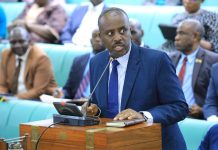

Minister of State for Regional Affairs Hon. John Mulimba has cautioned against unilateral actions by states in addressing conflicts in the Great Lakes region, saying peace and security can only be achieved through coordinated regional and international efforts.
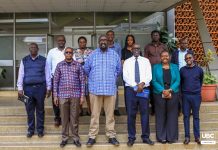
Mulimba made the remarks on February 12 during a courtesy call by H.E. Maria Hakansson, Ambassador of the Kingdom of Sweden, who met the minister in her capacity as the representative of Sweden, the current Chair of the International Contact Group for the Great Lakes.
Ambassador Hakansson informed the minister that Sweden assumed chairmanship of the International Contact Group for the Great Lakes in January 2026 for a six-month period. She said the role has generated renewed interest in Stockholm in the security situation in the region, particularly in relation to humanitarian needs and support to countries affected by conflict.
Mulimba congratulated Sweden on taking over the chairmanship and thanked the Swedish government for its continued role in promoting peace and security, not only in the Great Lakes region but across Africa. He reaffirmed Uganda’s position as a key player in regional integration and stressed the importance of collective approaches to addressing insecurity.
The minister underscored the need to harmonise regional initiatives with international processes, citing the Doha and Washington frameworks as important platforms for strengthening peace and security efforts in the region.
Mulimba also referred to Uganda’s hosting of the 12th High-Level Regional Oversight Mechanism (ROM) Summit at State House Entebbe in December 2025, noting that the meeting reaffirmed Uganda’s commitment to peace, security and cooperation in the Democratic Republic of Congo and the wider Great Lakes region. He said Uganda continues to support efforts aimed at harmonising contentious issues among regional actors.

In this context, Mulimba raised concerns about unilateral actions by states, warning that such approaches risk escalating tensions.
“What we are seeing today is a result of states taking unilateral decisions,” Mulimba said.
On the question of the United Nations recommendation on the drawdown of troops in Somalia, Mulimba called for a needs-based approach and what he described as “greater realism” by the international community in assessing the causes of insecurity and instability in the region.
He said security deployments should be informed by conditions on the ground rather than predetermined timelines.
The minister further revealed that the duration of Operation Shujaa, the joint Uganda–DRC military operation against the Allied Democratic Forces (ADF) in eastern Democratic Republic of Congo, will similarly be determined using a needs-based approach.