By Suzan Nawonga
When tragedy strikes on water, journalists are often among the first to arrive. Cameras rolling, notebooks open, journalists document grief, survival and loss. But behind the lens, many of these frontline storytellers carry a silent vulnerability — they lack the very survival skills that could save their own lives.
Apart from just tragedy, journalists are also exposed to water while covering stories on waters like fishing activities, flooding with some even using water transport as a means of transport say from their homes or to cover other activities.
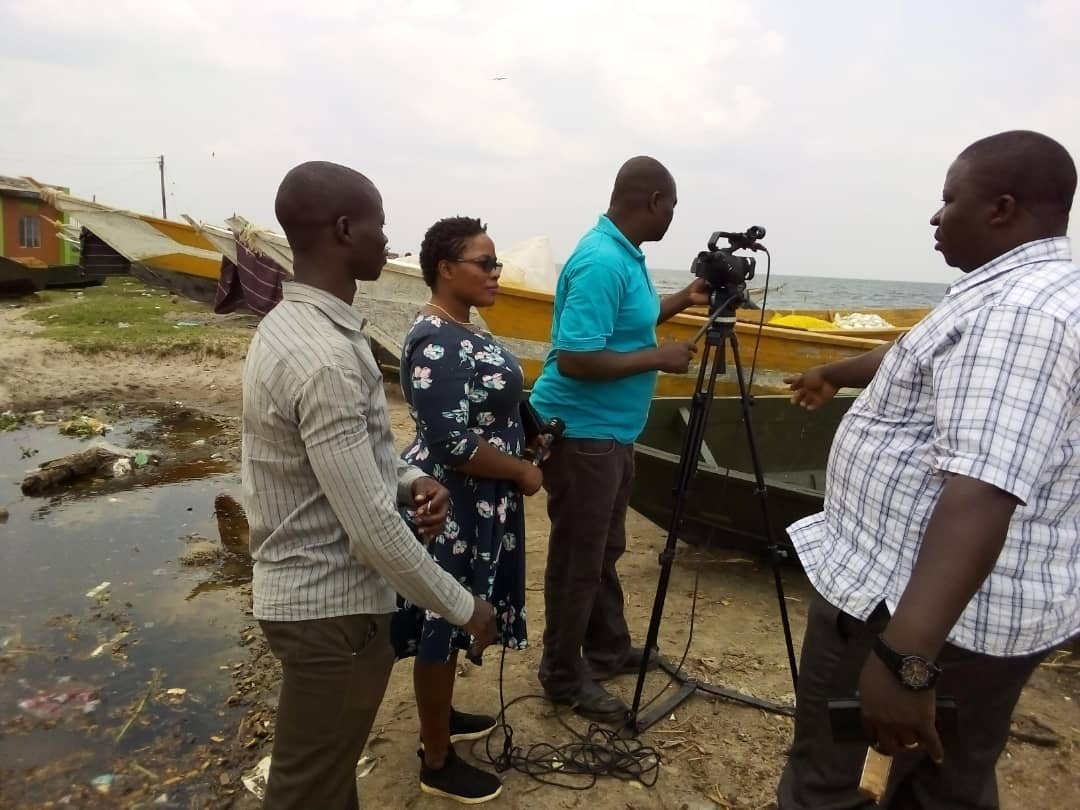
Henry Okurut, a senior journalist has covered numerous water-related incidents, like crackdown of illegal fishing on different water bodies. Henry knows how to swim but openly admits that he has no swimming skill to save his life in case of tragedy.
“I can swim,” he says, “but I don’t have survival swimming skills. If something went wrong in deep or rough water, I’m not sure I would make it.”
That acknowledgment reflects a wider gap in newsroom safety culture. Many journalists assigned to cover floods, boat accidents, lakeshore tragedies or fishing community stories often rely on basic swimming ability, if they have it at all. Few or none have even undergone structured survival swimming training.
Swimming to many is more of fun, exercise and Not Survival. Survival swimming has not be taken up with intention.
Survival swimming is staying alive in water under distress. It involves floating techniques, energy conservation, safe entry and exit, rescue awareness, and how to remain calm in currents or waves.
In unpredictable environments such as open lakes, fast-flowing rivers, or stormy conditions, knowing how to “stroke” through water does not guarantee safety. Panic, exhaustion, heavy equipment, and strong currents can quickly overpower even confident swimmers.
Journalists frequently operate close to danger, for example they board boats to capture exclusive footage, they wade into flooded communities, they position themselves at riverbanks or lakeshores to get better visuals, and in such moments, they are not just observers, they are exposed to danger.
A Frontliner Without protection.
Ironically, journalists covering drowning incidents often report on victims who lacked survival skills. Yet many in the profession have not taken proactive steps to equip themselves either. For example, during the 2018 MV Templar Boat incident where over thirty people lost their lives, storyline featured that many of the victims on the boat not only lacked protective gears but also had no survival swimming skills.
Henry acknowledges that despite repeatedly covering water-related stories, he has never formally trained in survival swimming. “We focus on the story. We don’t think about our own safety until it is too late,” he says.
This culture of urgency chasing breaking news quite often overshadows risk assessment. Protective gear, life jackets, and safety briefings are not always prioritized. Survival training is rarely mandatory in many media houses.
With the changing weather patterns for example in this month where metrology has issued alerts of anticipated heavy rains, journalists are likely to cover more water-related disasters.
This reality demands a shift, Survival swimming skills should no longer be optional. Newsrooms ought to make it essential for journalists assigned to water-related coverage.
A Call for Action
Media organizations can strengthen safety protocols by:
Making survival swimming training mandatory especially for field reporters like Henry Okurut, providing genuine life jackets and other safety gear during water assignments.
This can be accompanied by regular risk assessment briefings before deployment, creating partnernships with certified water safety trainers to provide survival swimming skills
Research by Makerere University School of Public Health shows drowning as a major yet under-reported killer in Uganda. It indicates that about 3,000 people drown every year, with eight to nine lives lost daily to drowning
Government Initiatives
It should be noted that government throught the Ministry of Internal Affairs is working on a National Drowning Prevention Strategy intended among others to guide operations in and around waters to reduce the burden