By Kooko Lawrence
The Inspector General of Government (IGG), Lady Justice Naluzze Aisha Batala, has outlined her priorities and early progress in the fight against corruption during her first 100 days in office.
Justice Naluzze was appointed by President Yoweri Kaguta Museveni in October 2025 and sworn in the following month. She heads the Inspectorate of Government, an independent body established under the 1995 Constitution and mandated to investigate corruption, enforce the Leadership Code, and handle complaints against public officials.
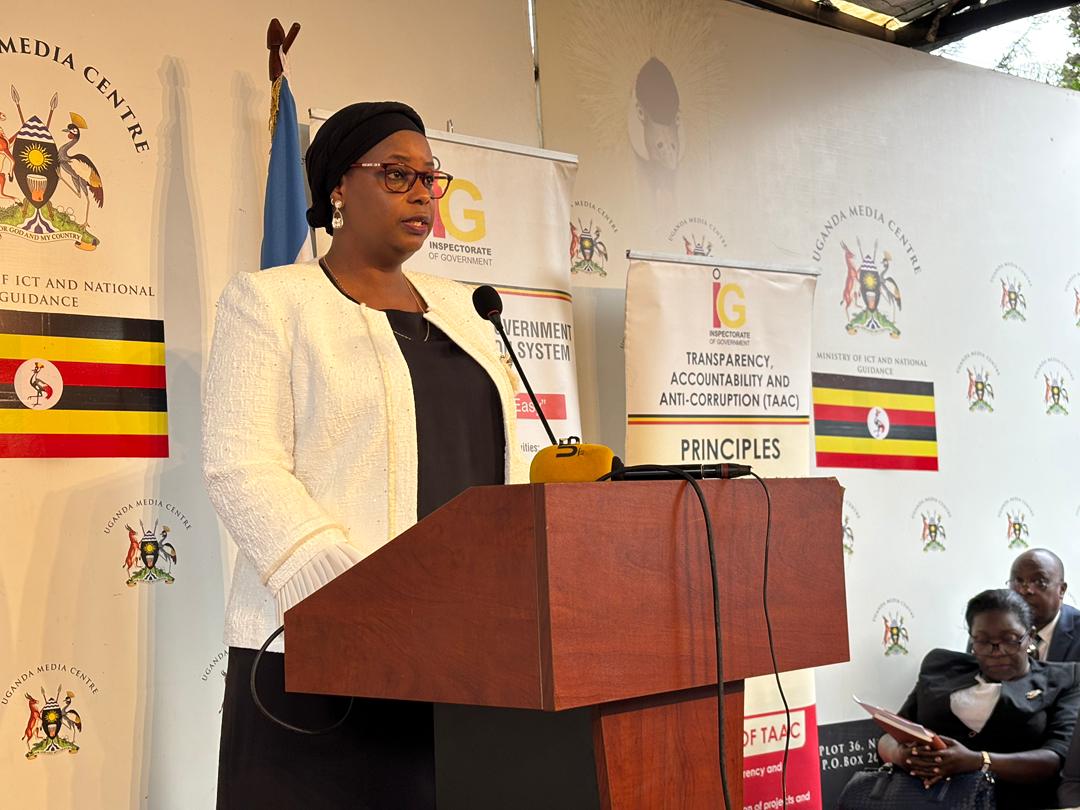
Speaking at a press briefing at the Uganda Media Centre, the IGG said the institution will focus on strengthening transparency, improving accountability, and making corruption harder to commit within public institutions.
“The message going forward is clear. We will deliver results, strengthen accountability, and pursue reforms that make corruption more difficult and less tolerated,” she said.
The Inspectorate’s work is organised around four areas: anti-corruption investigations, ombudsman services, enforcement of the Leadership Code, and research and public education. The IGG has powers to investigate, issue directives, freeze accounts, and recommend prosecution.
Justice Naluzze said her office is prioritising improvements in complaints handling through the IG Contact Centre, reducing delays in investigations, and digitising operations. She also emphasised prosecution-led investigations, including cases linked to money laundering.
“If we get you, our first action is to ensure that you are prosecuted,” she warned public officials.
According to the IGG, the Inspectorate registered 1,516 complaints during the last six months of 2025. Of these, 1,151 cases were sanctioned, while 308 corruption cases were investigated. The office also concluded 330 ombudsman matters, including 14 high-profile cases.
The Inspectorate recovered UGX 2,021,869,076 in misappropriated funds, while UGX 844,122,884 was paid to public officials whose salaries, gratuities or pensions had been delayed.
During the same period, 378 recommendations were implemented, and intelligence-led operations generated 27 new cases.
Justice Naluzze also carried out inspections in the regional offices of Kabale, Mbarara and Masaka, as well as spot checks at several regional referral hospitals. The inspections revealed overcrowding, non-functional equipment, medicine shortages and allegations of staff extortion.
Following one of the inspections, directives were issued that led to the reconstruction of a classroom block at Namwanzi Primary School in Kalungu District.
To strengthen investigations, 78 investigators and prosecutors have been trained in financial crime investigations, with closer collaboration established with the Criminal Investigations Directorate, the Anti-Corruption Court, and the Office of the Director of Public Prosecutions.
Between January and February 2026, IG orders resulted in 12 public officers being dismissed, four interdicted, three reprimanded, and one demoted. Unspent project funds were refunded and mismanaged district development funds recovered.
Active IG recovery orders currently stand at UGX 9,904,158,590, with UGX 2,411,599,875 already recovered.
Justice Naluzze, however, noted that the Inspectorate continues to face challenges including limited staffing, skill gaps, funding constraints and an aging vehicle fleet.
“Corruption is becoming more sophisticated and sometimes organised in networks,” she said.
Looking ahead, the IGG said the Inspectorate will strengthen cooperation with other anti-corruption agencies and push for stronger accountability measures across government programmes and projects.
She also reminded public officials to declare their income, assets and liabilities between April 1 and April 30, 2026, warning that failure to comply would lead to action by the Leadership Code Tribunal.
“The Inspectorate of Government will remain focused on protecting public resources and upholding public trust,” Justice Naluzze said.