

By Samuel Ssenono
MTN Uganda closed 2025 with another year of solid growth, driven increasingly by internet usage and mobile financial services as the telecom operator continues to evolve from a traditional voice network into a digital services platform.
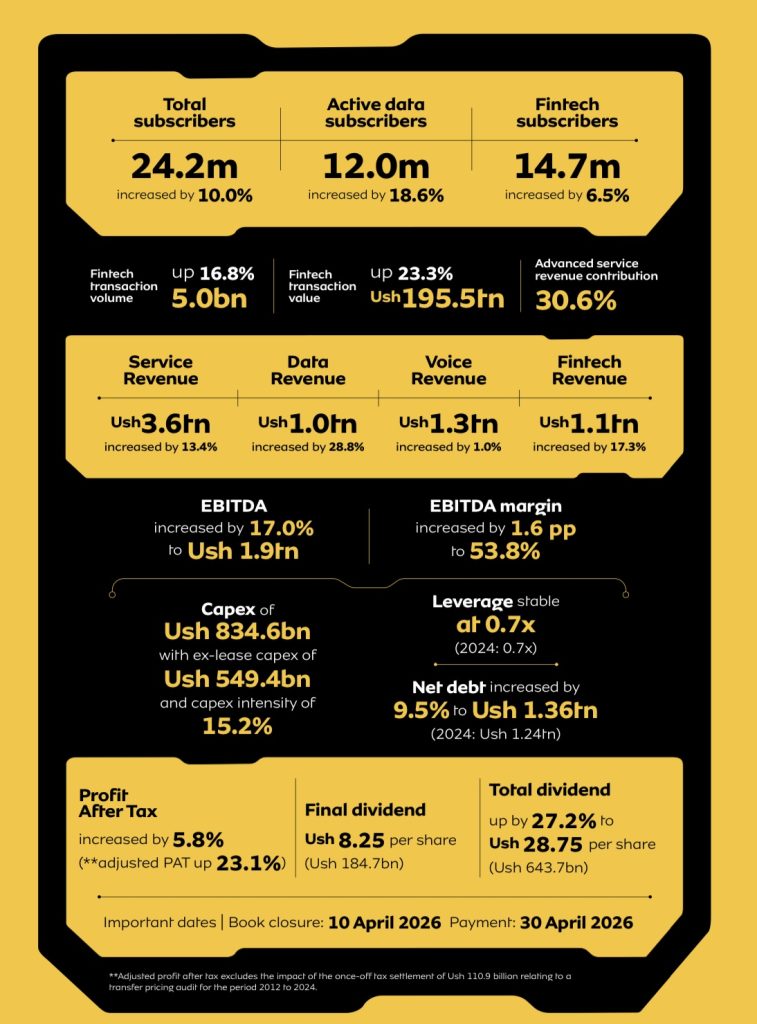
The company reported total revenue of Ush3.6 trillion for the year ended December 2025, up 13.6 percent from Ush3.17 trillion in 2024. Most of this income came from its core service lines, with service revenue reaching Ush3.57 trillion during the period.
Operational performance strengthened alongside revenue. Earnings before interest, tax, depreciation and amortisation (EBITDA) climbed 17 percent to Ush1.94 trillion, lifting the company’s operating margin to 53.8 percent. Net profit rose more modestly to Ush678.8 billion, though the figure was partly weighed down by a Ush110.9 billion one-off tax settlement linked to a transfer pricing audit covering the period from 2012 to 2024. Without this charge, adjusted profit growth would have been significantly stronger.
Behind the financial numbers lies a clear shift in how Ugandans are using telecom services.
Data Consumption Expands Rapidly
Mobile internet has become the fastest-growing segment of MTN Uganda’s business.
Data revenue increased by 28.8 percent to Ush1.05 trillion, fuelled by a surge in internet usage and a growing base of smartphone users. The network added 1.8 million new active data subscribers during the year, pushing the total to 12 million users. Data traffic rose by more than 50 percent, reflecting the growing role of smartphones in everyday communication, entertainment and commerce.
Smartphone penetration on the network now stands at 42.8 percent, supported in part by device financing programmes that allow customers to acquire smartphones through instalment payments.
As internet usage expands, data services are steadily taking a larger share of the company’s revenue mix, strengthening MTN’s position in Uganda’s digital economy.
Mobile Money Drives the Fintech Surge
Mobile money continues to reshape the telecom operator’s business model.
Fintech revenue rose 17.3 percent to Ush1.11 trillion, with mobile money accounting for the overwhelming share of this income. Revenue from mobile money services alone reached Ush1.09 trillion during the year.
Activity across the platform remains intense. The network processed five billion mobile money transactions worth Ush195.5 trillion during the year.
The ecosystem supporting this digital payments infrastructure is also growing in scale. MTN ended the year with 14.7 million active fintech users, supported by 241,000 mobile money agents and about 114,800 merchants across the country.
A rising share of fintech earnings now comes from more advanced financial services. Products such as merchant payments, savings tools and micro-lending solutions contributed about 30 percent of fintech revenue, illustrating how the mobile money platform is gradually evolving into a broader digital financial marketplace.
Voice Revenue Slows as Habits Change
While data and digital payments surged ahead, voice services continued to mature.
Voice revenue rose only 1 percent to Ush1.27 trillion, with its contribution to service revenue falling from 40.1 percent to 35.7 percent within a year.
The shift mirrors changing communication habits as customers rely more on messaging applications, social media platforms and internet-based calling services.
Despite slower growth in voice revenue, MTN’s subscriber base continued to expand. The company ended the year with 24.2 million customers, representing a 10 percent increase compared to the previous year.
Infrastructure Investment Intensifies
To support rising data consumption and maintain network quality, MTN Uganda continued to invest heavily in infrastructure.
Capital expenditure reached Ush834.6 billion during the year, with Ush549.4 billion allocated to network investment excluding leases.
By the end of 2025, 4G network coverage had reached 88.6 percent of Uganda’s population, while 3G coverage extended to 96.2 percent. The company also expanded its 5G rollout, bringing coverage to about 19 percent of the population.
MTN’s fibre infrastructure expanded rapidly as well. The company’s fibre network now stretches over 27,000 kilometres across the country, a 52 percent increase from the previous year.
These investments are partly driven by regulatory obligations under the company’s National Telecom Operator licence, which requires operators to expand connectivity across Uganda.
Strong Cash Generation and Dividends
Despite the scale of its infrastructure investments, MTN Uganda continued to generate strong cash flows.
Adjusted free cash flow rose to Ush1.1 trillion, supported by strong revenue growth and efficiency programmes that delivered Ush64.1 billion in cost savings during the year.
The board approved a final dividend of Ush8.25 per share, bringing the total dividend for 2025 to Ush28.75 per share, equivalent to Ush643.7 billion paid out to shareholders.
The company also announced a shift to quarterly dividend payments, a move designed to give investors more predictable returns throughout the year.
Telecoms Enter the Digital Finance Era
MTN Uganda now stands at the intersection of telecommunications and financial services.
The company plans to deepen investment in fibre connectivity, expand its home broadband footprint and strengthen its mobile money ecosystem through payments, lending and savings products.
The proposed structural separation of its fintech business currently under regulatory review could open the door to new investors and accelerate growth in digital financial services.