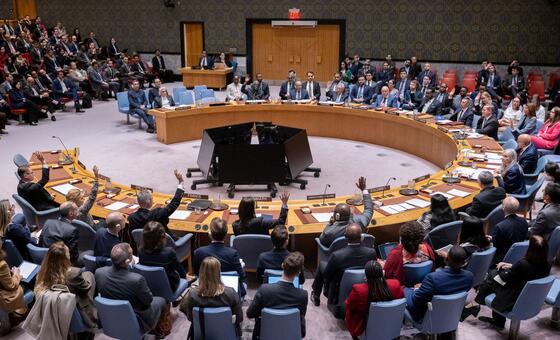
The UN Security Council has failed to adopt a resolution aimed at strengthening security in the Strait of Hormuz, as tensions continue to disrupt one of the world’s most critical shipping routes.
The draft resolution received 11 votes in favour but was vetoed by permanent members China and Russia. Colombia and Pakistan abstained.
The proposal sought to encourage countries using the Strait of Hormuz, which lies between Iran, Oman and the United Arab Emirates, to coordinate efforts to safeguard navigation, including escorting commercial vessels. It also called on Iran to immediately halt attacks on shipping and stop any actions that hinder freedom of movement through the strait.
The waterway remains a key global trade corridor, and disruptions have raised concerns over the flow of goods, including humanitarian supplies.
Gulf states express concern
The draft was tabled by Bahrain, alongside Jordan, Kuwait, Qatar, Saudi Arabia and the United Arab Emirates.
Speaking after the vote, Bahrain’s Foreign Minister Abdullatif bin Rashid Al Zayani said the Council had failed to act decisively.
“The Council failed to shoulder its responsibility in relation to an illegal conduct that requires decisive action with no delay,” he said.
He warned that the failure to pass the resolution sends the wrong signal globally, suggesting threats to international waterways could go unanswered.
US backs Gulf position
US Ambassador Mike Waltz said Washington stood with Bahrain and Gulf nations, warning that the situation in the strait has wider global implications.
“The Strait of Hormuz is too vital to the world to be used as hostage, to be choked, or weaponized by any one State,” he said.
He accused Iran of escalating tensions, saying the move threatened the global economy.
China, Russia oppose draft
Russia and China defended their veto, saying the resolution did not reflect the broader context of the conflict.
Russia’s Ambassador Vassily Nebenzia said the draft unfairly singled out Iran while ignoring actions by the United States and Israel.
China’s Ambassador Fu Cong said the proposal failed to address the root causes of the tensions and lacked balance.
Iran rejects accusations
Iran’s Ambassador Amir Saeid Iravani dismissed the draft, saying it sought to punish Iran while justifying actions by its adversaries.
He said Iran was acting to defend its sovereignty and interests in the Persian Gulf.
Veto blocks action
The failure of the resolution highlights divisions within the Security Council, where any of the five permanent members China, France, Russia, the United Kingdom and the United States can block action through veto power.
With no resolution adopted, uncertainty remains over efforts to secure the Strait of Hormuz, a vital artery for global trade and energy supplies.