By Joseph Mary Buwule
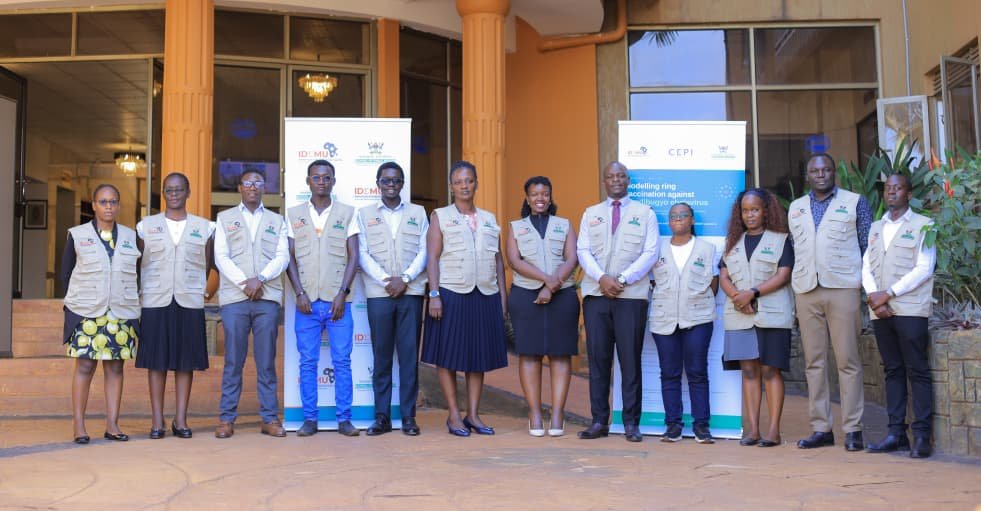
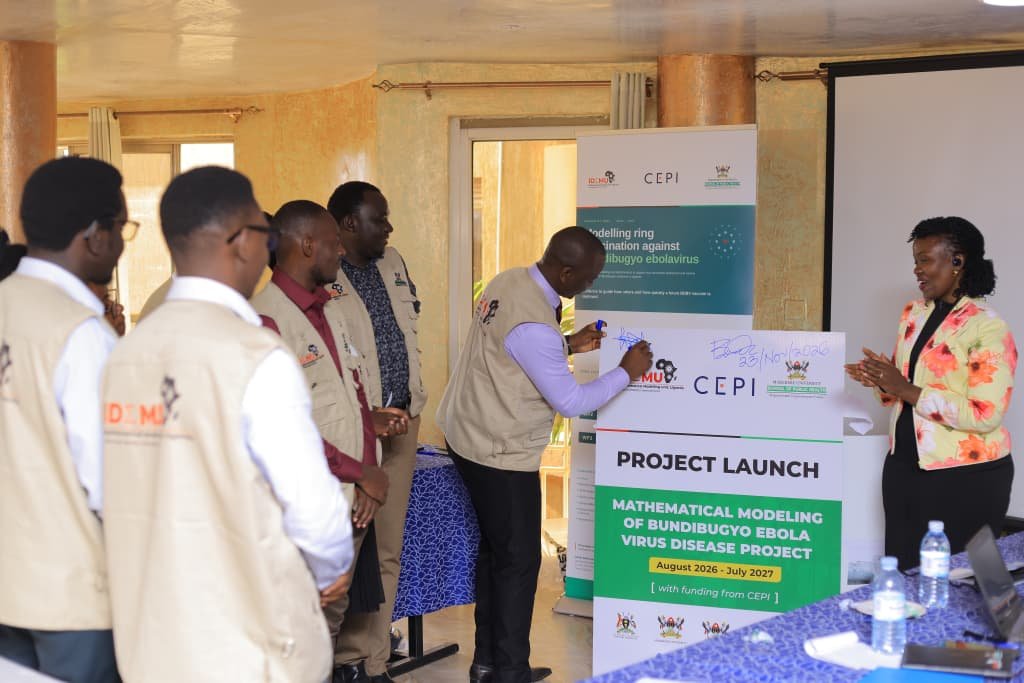
Makerere University School of Public Health (MakSPH) has launched a 12-month research project aimed at strengthening Uganda’s preparedness for future outbreaks of Bundibugyo ebolavirus through mathematical modelling, bioinformatics and vaccine research.
The project, funded by the Coalition for Epidemic Preparedness Innovations (CEPI), seeks to generate scientific evidence to guide vaccine development, vaccination strategies, clinical trial design and national preparedness against future outbreaks of the virus.
Led by Dr Abel Wilson Walekhwa, Principal Investigator and Co-Lead of the IDEMU Mathematical Modelling Unit at MakSPH, the initiative brings together seven research and public health institutions from Uganda, South Africa, the United States and the Democratic Republic of Congo.
The project comes at a time when Uganda faces the challenge of preparing for a strain of Ebola for which there is currently no licensed vaccine or specific medical countermeasure.
Bundibugyo ebolavirus was first identified in Uganda in 2007 following an outbreak in Bundibugyo District. The country experienced another outbreak in 2012, underscoring the need for sustained scientific research and investment in preparedness.
Unlike Zaire ebolavirus, against which vaccines and other medical countermeasures have been developed, existing licensed Ebola vaccines are species-specific and have not been demonstrated to protect against Bundibugyo ebolavirus.
Dr Walekhwa said the project seeks to address critical scientific gaps while strengthening Uganda’s capacity to respond to future filovirus threats.
The research will be implemented through three major work packages focusing on ring vaccination modelling, bioinformatics and vaccine design, as well as training and capacity development.
Under the ring vaccination modelling component, researchers are developing a mathematical transmission model calibrated using data from previous Ebola outbreaks in Uganda.
The model will be used to estimate the number of vaccine doses required during an outbreak, assess the feasibility of conducting ring vaccination trials and guide the design and implementation of future vaccine studies.
Ring vaccination involves immunising people who have been in contact with a confirmed Ebola case, as well as their contacts, to create a protective ring around the infected person and limit further transmission.
The modelling is expected to provide the Ministry of Health and other public health institutions with evidence to inform vaccine stockpiling, allocation and deployment strategies before an outbreak occurs.
The second component focuses on bioinformatics and vaccine design, with researchers examining the Bundibugyo ebolavirus proteome to identify promising vaccine targets.
The team is assessing potential vaccine epitopes, including their possible cross-reactivity with other ebolavirus species, before assembling them into a multi-epitope vaccine construct for computational evaluation.
The work is intended to identify promising candidates for further scientific investigation and laboratory validation.
Preliminary bioinformatics findings were presented to the CEPI Regional Centre at the Uganda Virus Research Institute (UVRI) on November 6, 2026.
Following the presentation, UVRI and Makerere University agreed to establish a collaboration supported by three technical working groups focusing on diagnostics, vaccines, and therapeutics and antivirals.
The collaboration is expected to provide a pathway for taking the computational research findings into laboratory validation and further scientific assessment.
The third component will strengthen Uganda’s human resource capacity through specialised training for nine public health fellows in mathematical modelling, bioinformatics and data analytics.
The fellows will undergo a residential training programme combining theoretical instruction with supervised practical research projects to equip them with skills needed to analyse emerging infectious diseases and support evidence-based public health decision-making.
The fellowship programme attracted more than 120 applications from across Africa following the closure of the application process, with selection currently underway.
The project is also strengthening engagement with the Ministry of Health, whose Department of Health Information has proposed the establishment of a modelling think tank to address priority public health questions.
The proposed arrangement will involve monthly virtual meetings and quarterly physical engagements, with findings and recommendations presented to the Director General of Health Services.
The initiative brings together Makerere University School of Public Health, the Ministry of Health, Uganda Virus Research Institute, the African Centre of Excellence in Bioinformatics and Data-Intensive Sciences, the University of Cape Town, the University of California, Berkeley, and Kinshasa School of Public Health in the Democratic Republic of Congo.
The University of Cape Town’s Modelling and Simulation Hub, Africa (MASHA), and the University of California, Berkeley, will contribute modelling methodologies, analytical support and scientific review, while Kinshasa School of Public Health will contribute cross-border epidemiological expertise and assess the regional applicability of the findings.
Dr Walekhwa said the project will provide Uganda and regional public health institutions with evidence to support vaccine planning and clinical trial design while building local expertise to respond to future filovirus threats.
He said investing in local scientific capacity would ensure that Uganda develops the expertise needed to address emerging public health emergencies rather than relying entirely on external research institutions.
The project is expected to strengthen collaboration between national and international research institutions while creating a more sustainable scientific foundation for outbreak preparedness.
Through the combination of mathematical modelling, bioinformatics, vaccine research and specialised training, the initiative seeks to improve Uganda’s ability to anticipate, prepare for and respond to future Bundibugyo ebolavirus outbreaks.