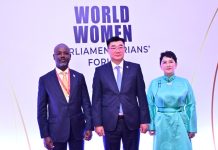
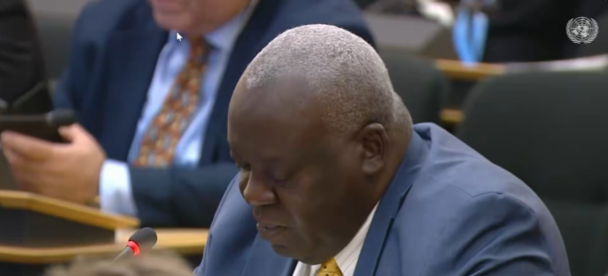
Geneva, Switzerland – The Minister for Relief, Disaster Preparedness and Refugees, Hon. Sam Engola, addressed the 77th Session of the UNHCR Executive Committee (ExCom) in Geneva, where he called upon the international community to move beyond pledges and deliver tangible results for refugees and host communities.
The Minister was accompanied by Ambassador Marcel Robert Tinaleka, Uganda’s Permanent Representative to Switzerland, and the Ag. Commissioner for Refugee Management.
The address comes as the world marks the 75th anniversary of the 1951 Refugee Convention.
A Moment of Strain
Hon. Engola noted that the principles embodied in the 1951 Refugee Convention are under acute strain. Refugee protection, international solidarity, and multilateral cooperation are being tested by increasingly complex and protracted crises, as well as growing pressure on host countries in an uncertain funding environment.
“As we mark the 75th anniversary of the 1951 Refugee Convention, we do so at a moment when the principles it embodies are under acute strain,” he said.
The Global Compact on Refugees
The Minister emphasized that the Global Compact on Refugees is not simply a process but the international community’s agreed framework for turning responsibility-sharing into practical support for refugees, host communities, and the countries that welcome them.
“As Global Refugee Forum 2023 co-convenors and co-hosts—Colombia, France, Japan, Jordan, Switzerland, Uganda, and UNHCR—we reaffirm the importance of this framework and the need to use it with renewed purpose,” Hon. Engola stated.
From Mobilization to Delivery
Hon. Engola stressed that the measure of success is not the number of pledges made, but whether they improve the lives of refugees and host communities, strengthen national systems, expand inclusion and self-reliance, and open pathways to solutions.
“Pledges are not an end in themselves; they must be matched with adequate resources, translated into implementation, and assessed by the results they deliver for displaced persons and host communities,” he said.
The Minister cited existing inclusion initiatives, such as Ethiopia’s Makatet and Kenya’s Shirika Plans, as examples of how the GCR can support nationally led approaches and contribute to the 50 by 35 vision and UNHCR-mandated operations.
A Call for Collective Action
Looking ahead to the next Global Refugee Forum in 2027, Hon. Engola called on all stakeholders to use the coming period to sharpen priorities, demonstrate results, and prepare commitments that respond to the scale of today’s displacement challenges.
He called for collective action to:
Deliver on existing pledges and communicate clearly the changes they are making for refugees, stateless persons, host communities, and host countries.
Support host country leadership through predictable financial, technical, and material cooperation that responds to identified needs, bringing together all relevant actors around shared outcomes linked to GCR objectives and the 50 by 35 vision.
Promote participation and leadership of refugees, stateless persons, and host communities in the design, implementation, and monitoring of policies and pledges that affect their lives.
Engage actively in the preparations for the 2027 Global Refugee Forum, including by taking stock of progress, identifying priorities, and shaping commitments that are ambitious, realistic, and grounded in the needs of refugees, stateless persons, host communities, and host countries.
A Vehicle for Concrete Progress
The Minister reaffirmed Uganda’s commitment, as a co-convenor and co-host, to working with all stakeholders to carry this agenda forward.
“The road to the 2027 Global Refugee Forum should be used to show that the GCR is not only a statement of solidarity, but a vehicle for concrete progress in the lives of people and communities affected by displacement,” he said.
“We therefore call for renewed political leadership, practical cooperation, and sustained engagement to ensure that the Global Compact on Refugees continues to deliver where it matters most: for refugees, host communities, and the countries that stand with them.”
For God and My Country.