By Wadulo Arnold Mark
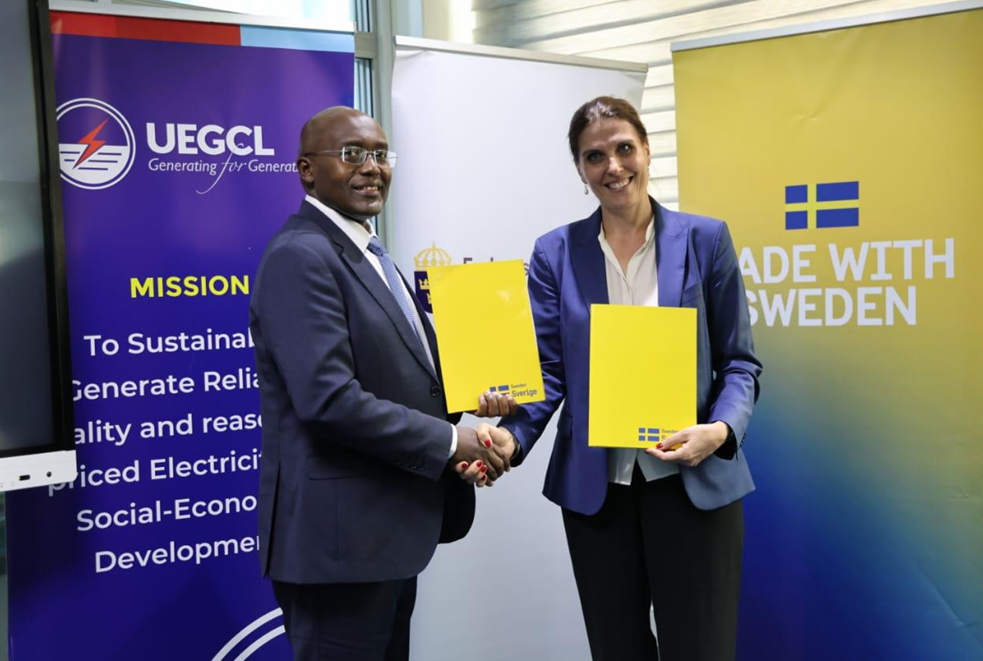
The energy cooperation between Uganda and Sweden registered a major milestone on Monday 16th November 2026, following the signing of a strategic grant agreement to advance the proposed 10-Megawatt (MW) floating solar pilot plant on the Isimba reservoir.
The agreement was signed and exchanged at the Uganda Electricity Generation
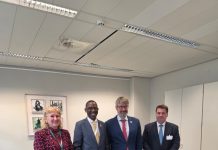
Company Limited (UEGCL) head offices in Kampala during an official visit by the Swedish Ambassador to Uganda, H.E. Anna-Maria Olsson. Ambassador Olsson represented Swedfund—the Swedish government’s development finance institution—while UEGCL Chief Executive Officer Dr. Eng. Harrison E. Mutikanga signed on behalf of the state power generator.
The newly signed grant provides essential additional financing for consultancy services to hire an “Owner’s Engineer”—the specialized technical consultant tasked with supervising the design, construction, and initial operational phases of the Isimba floating solar plant.
Monday’s milestone builds directly upon an earlier $698,000 (Shs 2.7 billion) grant secured from Sweden’s Swedfund in October 2021, under then Swedish Ambassador Maria Håkanson. That initial funding financed comprehensive feasibility studies conducted across major hydroelectric reservoirs, including Nalubaale, Kiira, Bujagali, Karuma, and Isimba.
With feasibility studies successfully proving the viability of floating solar technology in East Africa, the latest grant moves the project from conceptual planning into technical execution.
The pioneer project introduces an innovative engineering model by placing solar panels directly onto the water surface of the Isimba dam reservoir, enabling Uganda to expand clean energy generation without additional land requirements.
By utilizing the existing reservoir surface, the facility completely avoids land acquisition costs and prevents the displacement of local farming communities. Furthermore, the floating solar installation connects directly into Isimba’s existing power evacuation infrastructure, sharing the high-voltage transmission grid already built for the hydro turbines.
Operationally, floating solar panels deliver a dual advantage. Shading the reservoir surface reduces water evaporation during hot dry seasons, conserving water for hydro power generation. In turn, the natural cooling effect from the water keeps the solar panels at optimal temperatures, boosting their generation efficiency when river flows drop.
Uganda’s total installed electricity generation capacity currently stands at approximately 2,100 megawatts (MW), generating an estimated $72 million annually from electricity exports to neighboring countries in the East African region. However, domestic energy consumption is expanding rapidly alongside industrialization.
Speaking after the signing ceremony, UEGCL Executive Director Dr. Eng. Harrison E. Mutikanga emphasized that swift implementation is crucial to prevent upcoming energy deficits.
“We expect hopefully by May next year we should have finalized the procurement process for the owner’s engineer,” Dr. Mutikanga stated. “Concurrently, we are finalizing the PPA (Power Purchase Agreement) with UETCL for a power purchase agreement, and that will lead us to applying for a generation license”.
Warning of rapid demand growth, Dr. Mutikanga stressed the urgency of adding new generation capacity. “Demand is increasing so fast, and if we don’t do anything very quickly, then next year we might have an issue of demand outstripping generation capacity,” Dr. Mutikanga explained.
“It’s a high growth in demand… Yet one project like hydro takes 10 years. If we are to start a project today, it will be 10 years before we produce the first megawatt from that project” another UEGCL official stated
While UEGCL works alongside the Ministry of Finance and international allies including the African Development Bank and partners in the Netherlands to mobilize the $15 million needed for full plant construction, the Swedish grant guarantees that technical design and licensing proceed without delay.
Beyond capital financing, the Uganda–Sweden partnership places strong emphasis on institutional capacity building and skills transfer.
The project supports technical skilling programs designed to empower Ugandan engineers and technicians to operate, monitor, and maintain the floating solar facility upon commissioning.
Reaffirming Sweden’s long-term commitment, Ambassador H.E. Anna-Maria Olsson commended UEGCL’s forward-looking leadership in exploring innovative electricity generation.
“Access to clean, reliable, and affordable energy is fundamental to industrial development, job creation, improved livelihoods, and long-term climate resilience,” Ambassador Olsson stated. “Our ambition is to continue aligning Swedish expertise, financing, and private sector engagement with Uganda’s national priorities and development objectives”.