By Wadulo Arnold Mark
KAMPALA – Uganda’s Ministry of Finance has released Shs 21.82 trillion for the second quarter of FY 2026/27 to fund government operations, amidst intense economic debates surrounding rising fuel prices, a weakening shilling, and a sharp interest rate hike by the central bank.
The massive release comes at a time when headline inflation rose to 4.6% in September, driven by global crude oil price spikes from $60 reaching $104 per barrel and heavy dollar demand from energy and telecom importers. To halt the shilling’s rapid slide—which recently passed 4,000 against the US dollar—the Bank of Uganda aggressively raised its Central Bank Rate (CBR) from 9.75% to a historic 12%.
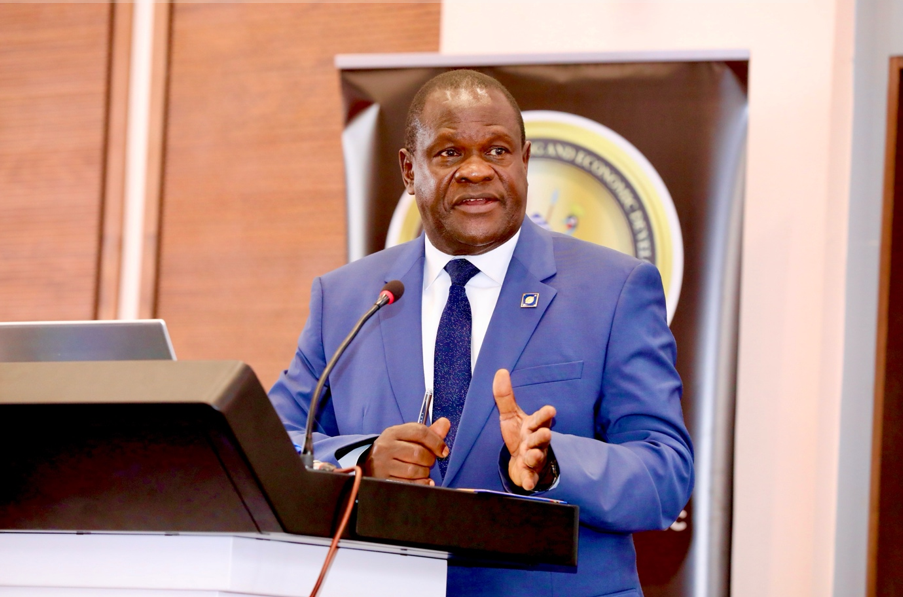
Defending the rate hike during the budget release, the Deputy Permanent Secretary and Secretary to the Treasury (DPSST) Patrick Ocailap admitted that higher interest rates make loans more expensive for local businesses, but insisted that taking action was unavoidable.
“There is a cost to everything. You cannot have a cost-free economic policy, or monetary or fiscal policy,” the Deputy PSST explained. “Would you rather continue with the shilling sliding the way it was sliding, and with inflation going the direction it’s going, most of it being imported through the exchange rate? Would you rather continue that trend? The answer is certainly no. You’ll be totally irresponsible and you’ll reach a situation where most of the things will be unaffordable and inflation will hit the roof. So there is a cost to that slight increase in the interest rate… but it’s better to pay that cost than do nothing.”
However,in an exclusive virtual interview, principal economist Dr. Fred Muhumuza sharply disputed the government’s approach, arguing that raising interest rates is the wrong prescription because domestic monetary tightening cannot cure external global inflation.
“I think this is a wrong time to take that decision, knowing very well an increase in the central bank rate and related rates that follow is not going to resolve the current problem because it’s global,” Dr. Muhumuza stated. “If you look at money supply, the biggest contributor over the last five years has been government contribution, which is part of government borrowing. So you’re punishing the wrong party. Private sector credit has been growing at a moderate rate. The real driver, if you really want to curtail inflation by addressing money supply, is targeting fiscal spending and not private sector spending.”
Dr. Muhumuza added that interest rates were already too high, causing severe market distortions where wealthy investors choose to buy government bonds rather than invest in local factories or agriculture, forcing Uganda to rely heavily on costly imported goods.
Despite these opposing viewpoints, the Finance Ministry proceeded with disbursing the Q2 funds to maintain core services:
- Public Debt: Shs 10.75 trillion to cover maturing debt obligations and treasury operations.
- Salaries & Pensions: Shs 2.42 trillion for civil service wages and Shs 376.6 billion for pensions.
- Transport Infrastructure: Shs 1.48 trillion allocated to roads, railways, and Uganda Airlines.
- Health & Medicine: Shs 416.5 billion for health operations and Shs 284.7 billion to the National Medical Stores.
- Local Governments: Shs 457.4 billion disbursed to districts across the country.