By Joseph Mary Buwule
Uganda has launched an ambitious ten-year strategy aimed at transforming its cocoa industry into a competitive, climate-resilient and high-value agricultural sector, with targets to increase annual production to 500,000 metric tonnes, raise export earnings to USD 3 billion and expand domestic processing.
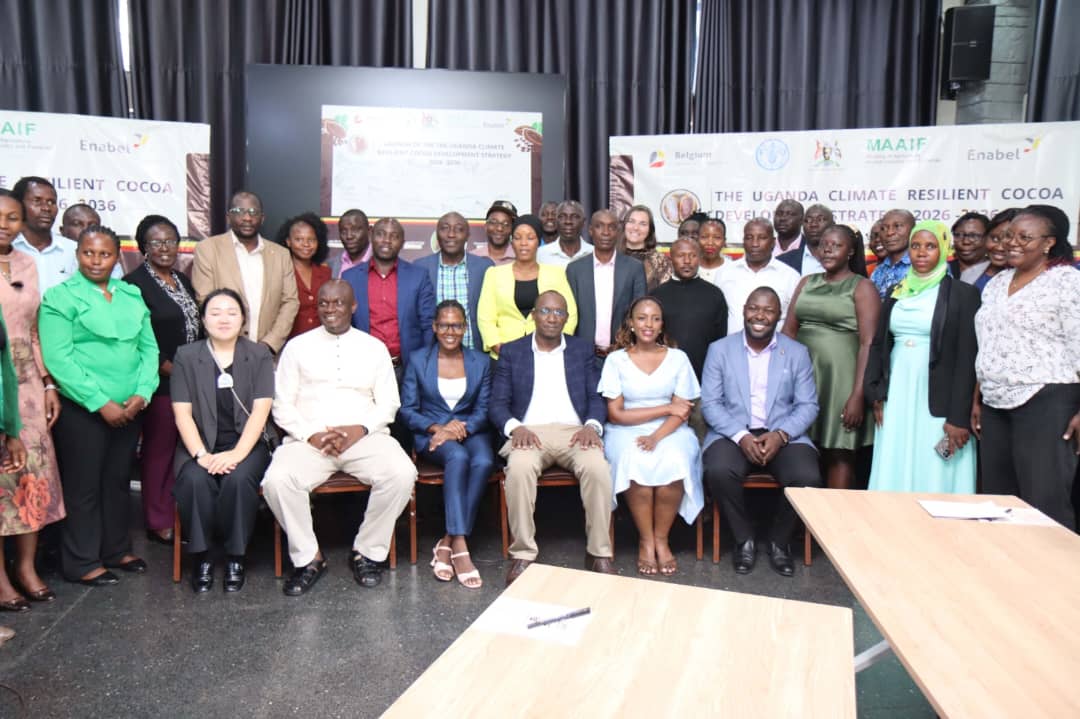
The Uganda Climate Resilient Cocoa Development Strategy (2026–2036), launched by the Ministry of Agriculture, Animal Industry and Fisheries (MAAIF), provides a national framework for coordinated investment, policy implementation and interventions across the entire cocoa value chain.
Developed with support from the Food and Agriculture Organization of the United Nations (FAO), the Belgian Agency for International Cooperation (Enabel) and other sector partners, the strategy seeks to address longstanding challenges affecting cocoa production while positioning Uganda to benefit from growing opportunities in international cocoa markets.
Cocoa has emerged as one of Uganda’s most important agricultural export commodities, generating significant foreign exchange earnings and supporting rural livelihoods.
According to figures from MAAIF and the Bank of Uganda, cocoa export earnings increased from USD 70.6 million in the 2015/2016 financial year to USD 620.4 million in FY2024/2025.
This growth has elevated cocoa to Uganda’s second-leading agricultural export and third-largest foreign exchange earner after gold and coffee, supporting more than 100,000 cocoa-growing households across the country.
However, despite the sector’s impressive export performance, the government says there is considerable untapped potential to increase productivity, improve the quality of cocoa beans, expand local processing and ensure farmers receive greater benefits from the industry.
Under the new strategy, Uganda targets increasing annual cocoa production from approximately 72,000 metric tonnes to 500,000 metric tonnes by 2036.
The country also intends to increase average farm productivity from the current 530 kilograms per hectare to 1,000 kilograms per hectare, while raising the proportion of cocoa processed locally from less than five per cent to at least 30 per cent of national production.
The strategy further targets annual export earnings of USD 3 billion and seeks to increase the participation of women and young people in the cocoa value chain to at least 45 per cent.
Speaking at the launch, Dr. John Lodungokol, Acting Commissioner for Crop Production and Protection at MAAIF, said the strategy provides a clear roadmap for coordinating interventions and mobilising resources to unlock the sector’s potential.
“The strategy sets out a clear direction for the development of Uganda’s cocoa sector over the next ten years. Our priority now is to strengthen coordination across the value chain, mobilise the necessary investment and ensure that farmers, processors and other stakeholders are equipped to contribute to and benefit from the sector’s growth,” Lodungokol said.
He emphasised the need to translate the ambitious targets into practical interventions that address production constraints, strengthen the capacity of farmers and attract investment into processing and other value-adding activities.
Addressing productivity and climate challenges
Despite the rapid growth in cocoa exports, Uganda’s cocoa industry continues to face structural challenges that threaten its long-term competitiveness.
These include low farm productivity, inadequate post-harvest handling facilities, limited access to improved planting materials, weak farmer organisations, insufficient financing and limited domestic processing capacity.
The sector is also increasingly exposed to climate-related risks, including changing rainfall patterns, prolonged dry spells, rising temperatures and other environmental pressures that affect crop performance and quality.
The new strategy therefore places climate resilience at the centre of cocoa sector development, promoting climate-smart agricultural practices, agroforestry, sustainable land management, improved planting materials and environmentally responsible production systems.
These interventions are intended to strengthen the ability of cocoa-growing communities to withstand climate shocks while improving productivity and protecting the natural resources on which agricultural production depends.
The strategy also recognises the growing importance of international market requirements, particularly traceability and deforestation-free production.
As global cocoa markets increasingly demand evidence of sustainable sourcing and responsible agricultural production, Uganda will need to strengthen systems for tracking cocoa from farms to export markets.
Improving traceability is expected to help farmers, exporters and processors meet international standards, maintain market access and position Ugandan cocoa as a reliable and sustainably produced commodity.
FAO calls for investment in research and value addition
The Food and Agriculture Organization of the United Nations reaffirmed its commitment to supporting Uganda’s ambition to become a competitive player in the global cocoa industry.
FAO emphasised that increasing production alone would not be sufficient to transform the sector, noting that sustained investment in research, innovation, climate resilience, value addition and institutional capacity would be critical.
Dr. Joseph Mudiope, Crop Production Specialist at FAO Representation in Uganda, said the country has a significant opportunity to strengthen its position in the international cocoa market but must address the wider requirements of a modern and competitive value chain.
“Uganda has a significant opportunity to become a competitive player in the global cocoa market. Realising this potential will require more than increasing production; it calls for sustained investment in research, innovation, climate resilience and value addition,” Mudiope said.
FAO’s support to the strategy was provided through its Technical Cooperation Programme under the initiative titled Strengthening Uganda’s Capacity for Climate-Resilient Cocoa Value Chain Development.
The process involved technical reviews, expert consultations and engagement with stakeholders drawn from government institutions, the private sector, farmer organisations, academia and development partners.
The organisation said strengthening national capacities and systems would be essential to ensuring that the strategy delivers sustainable results over its ten-year implementation period.
Focus shifts to domestic processing and agro-industrialisation
A major priority under the strategy is to ensure that Uganda retains more economic value from its cocoa production instead of relying predominantly on exports of raw or minimally processed beans.
Currently, less than five per cent of the country’s cocoa production is processed locally, leaving significant opportunities for investment in domestic agro-processing.
The government intends to increase local processing capacity to at least 30 per cent by 2036 through investments in fermentation, drying, aggregation and industrial processing.
The strategy specifically identifies opportunities in the production of cocoa liquor and chocolate, among other cocoa-derived products.
Expanding domestic processing is expected to create new business opportunities, stimulate industrial development, generate employment and improve market opportunities for farmers and other value-chain actors.
It is also expected to strengthen linkages between cocoa producers, cooperatives, exporters, manufacturers and other private sector players.
By encouraging investment in processing and manufacturing, Uganda hopes to transition from being primarily a supplier of agricultural raw materials to becoming a producer and exporter of higher-value cocoa products.
USD 221 million investment required
Implementing the strategy will require substantial financial resources and coordinated participation from both public and private sector actors.
The estimated public and catalytic investment requirement over the ten-year period stands at USD 221.19 million.
The strategy calls for government leadership and coordinated support from development partners, financial institutions, research organisations, farmer organisations and private investors.
Private sector investment is expected to play a particularly important role in expanding processing infrastructure, improving access to agricultural inputs, strengthening market linkages and developing commercially viable cocoa enterprises.
For Enabel, the Belgian Agency for International Cooperation, the strategy provides an opportunity to build on existing partnerships while strengthening the relationship between agricultural development, private sector growth and employment creation.
Sylivia Natandula, Agribusiness Expert representing Enabel, said the success of the strategy should ultimately be judged by its impact on farmers, businesses and communities rather than production and export figures alone.
“Ultimately, our success should not be measured only by the tonnes of cocoa produced or exported, but by the incomes improved, businesses strengthened, decent jobs created and communities transformed,” Natandula said.
Her remarks highlight the importance of ensuring that the anticipated growth in production and exports translates into tangible improvements in household incomes, employment opportunities and the economic well-being of cocoa-growing communities.
Regional consultations to support implementation
Following the national launch, the Ministry of Agriculture and its partners plan to undertake regional engagements in Eastern, Western and Northern Uganda.
The consultations will seek to increase awareness of the strategy, strengthen ownership among local stakeholders and identify specific opportunities and priorities for implementation in existing cocoa-producing and potential growing areas.
The engagements are also expected to provide a platform for farmers, local leaders, agricultural institutions, private sector players and other stakeholders to contribute to the implementation process.
The regional approach is intended to ensure that interventions respond to the realities of different cocoa-growing communities and that farmers are actively involved in shaping the future of the industry.
Positioning cocoa as a driver of economic growth
The launch of the Uganda Climate Resilient Cocoa Development Strategy comes at a time when the country is seeking to diversify its agricultural exports, strengthen agro-industrialisation and increase the contribution of value-added agricultural products to the economy.
With cocoa exports already generating hundreds of millions of dollars annually, the government sees the commodity as an important opportunity for expanding foreign exchange earnings, creating rural employment and improving the livelihoods of farming households.
However, achieving the 2036 targets will depend on how effectively the government and its partners address existing production and market constraints, mobilise the required USD 221.19 million investment and attract private sector participation.
It will also require sustained attention to climate adaptation, research, quality assurance, farmer organisation, access to finance and compliance with international market standards.
If successfully implemented, the ten-year strategy could transform Uganda’s cocoa industry from a predominantly raw-bean export sector into a more productive, diversified and value-added industry, strengthening the country’s position in the global cocoa market while ensuring that farmers and local communities benefit from its growth.