
By Tumwine Byaruhanga
Government has launched Skeepon Technology, a Japanese crop treatment meant to help farmers protect yields during dry spells, heat and unreliable rainfall.
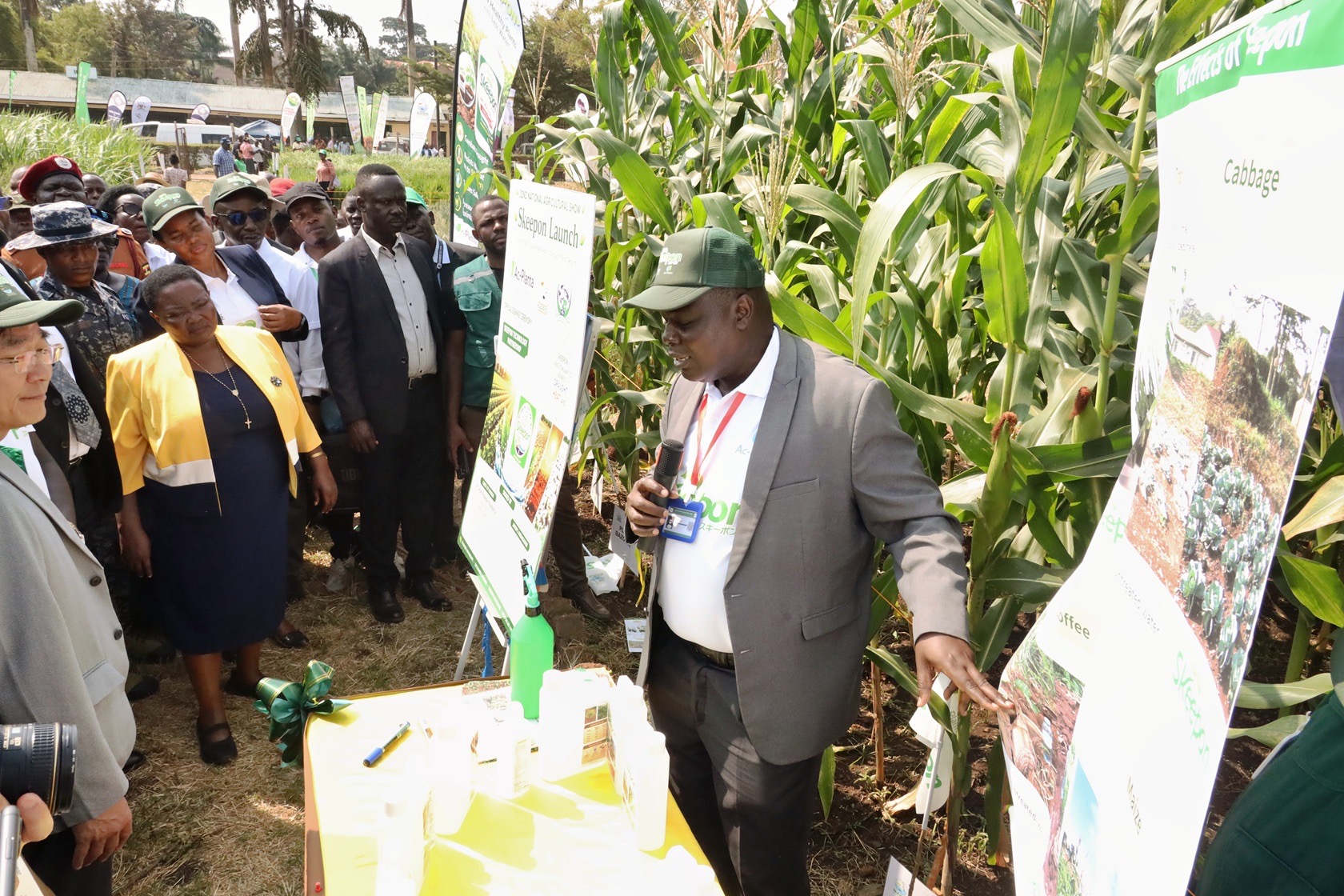
The technology was launched by Prime Minister Robinah Nabbanja at the 2026 National Agricultural Show in Jinja, as government looks for practical ways to reduce climate-related losses in agriculture.
Skeepon is a plant biostimulant. It is applied to crops to activate their natural defence against drought and heat stress. According to agricultural researchers, the treatment helps crops keep growing under water stress for up to three months.
The technology comes at a time when farmers are facing longer dry periods, rising temperatures and irregular rainfall. These conditions have affected food production, reduced household incomes and increased the risk of crop failure, especially in rain-fed farming areas.
Speaking at the launch, Nabbanja said climate change remains one of the biggest threats to Uganda’s agriculture sector. She said government would support technologies that help farmers produce more despite unpredictable weather.
“Climate change continues to pose one of the greatest threats to our agricultural sector. Government will continue supporting technologies that improve resilience, increase productivity and enhance household incomes,” Nabbanja said.
The technology has been introduced through a partnership between the Ministry of Agriculture, Animal Industry and Fisheries, the National Agricultural Research Organisation, the Office of the Prime Minister and Ac-Planta Inc., a Japanese agricultural biotechnology company.
Before the national rollout, Skeepon was tested under Ugandan farming conditions by NARO. The trials were conducted over two cropping seasons.
According to NARO, crops treated with Skeepon performed better than untreated crops. The trials recorded more than 30 percent higher maize yields and over 45 percent higher vegetable yields. Researchers also reported faster crop growth, better plant vigour and stronger tolerance to drought and heat.
NARO Director General Dr Yona Baguma said the results show how agricultural research can provide practical answers to problems faced by farmers.
“This innovation demonstrates the power of science in solving real problems facing our farmers. NARO’s mandate is to generate technologies that improve productivity, build resilience and support agro-industrialisation,” Baguma said.
Government says Skeepon is not a replacement for irrigation, fertilisers or improved seed, but can work alongside them. It can also benefit farmers who depend entirely on rainfall and may not have access to irrigation.
The collaboration with Ac-Planta followed engagements at the Uganda-Japan Business Forum in December 2022, where Prime Minister Nabbanja met the company’s founder. MAAIF and NARO later entered into a research collaboration with the company to validate the technology locally before registration and deployment.
Government says the product will cost between Shs12,000 and Shs27,000 per acre, depending on the crop and application. Officials say this makes it a relatively affordable option for smallholder farmers seeking to reduce drought-related losses.
Skeepon is already used commercially in Japan, the United States and South Korea. Government says Uganda will also explore local formulation and manufacturing if demand grows, a move officials say could reduce import costs and create jobs.
NARO Holdings Limited, the commercial arm of NARO, will coordinate distribution. The rollout will involve government agencies, extension workers, farmer groups, cooperatives, agro-input dealers and private distributors.
Government also plans to link the technology to farmer-friendly delivery models, including input packages, credit arrangements and partnerships with agro-processors.
The rollout follows concerns raised by farmers during recent Parish Development Model assessment tours, where many pointed to erratic weather, low access to irrigation, limited use of improved technologies and declining productivity as major constraints.
Government says the technology is expected to support food security, improve farmer incomes, increase the supply of raw materials for agro-processing and strengthen Uganda’s climate-smart agriculture agenda.