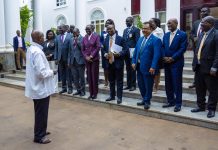
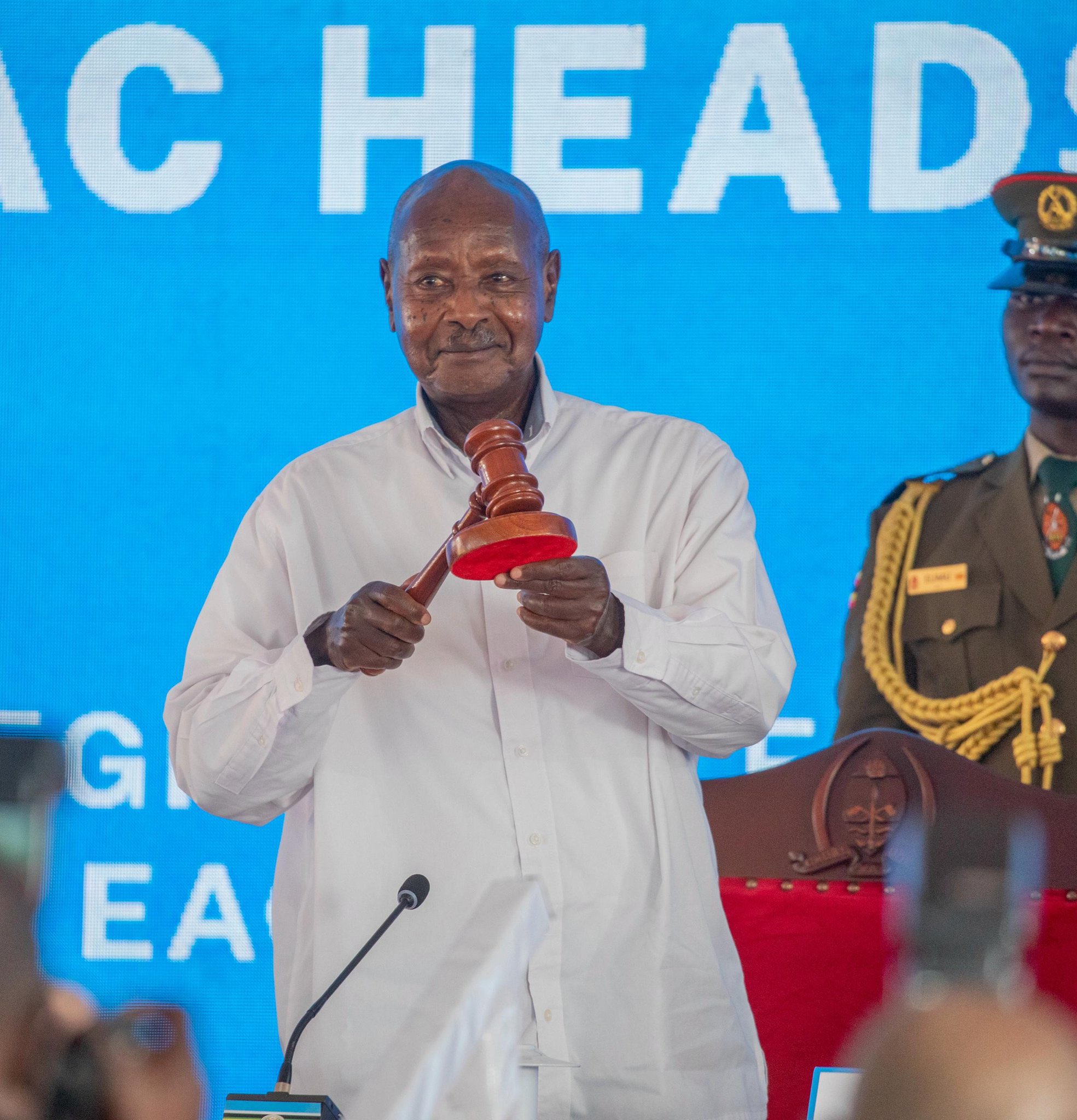
President Yoweri Kaguta Museveni recalled his final meeting with Tanzania’s founding leader Mwalimu Julius Nyerere during an address to East African leaders, using the memory of that “last supper” in Arusha to renew calls for African unity, economic integration and strategic security.
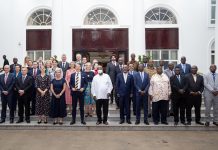
Speaking at the 25th Ordinary Meeting of the East African Community Heads of State on 7 March 2026 in Arusha, Tanzania, Museveni said the issues he discussed with Nyerere years ago remain central to Africa’s future, warning that the continent risks “mis-cooking the African revolution” if it fails to pursue unity and integration.
Below is the full speech as delivered.
OKUKONESA (KUFUBYA) THE AFRICAN
REVOLUTION — MIS-COOKING THE AFRICAN
REVOLUTION.
Your Excellencies, the EAC Heads of State,
The delegation Leaders,
The Secretary General,
Members of the Diplomatic Corp,
Ladies and Gentlemen.
Greetings from the People of Uganda. Thanks for electing me to chair the EAC Authority for the next one year. At this point in history and given my 65 years of either watching closely or being right in the centre of events on our much troubled Continent, I feel compelled to use this occasion to bring up the issue of Okukonesa (Kufubya — mis-cooking the African Revolution). Kukonesa (Kufubya), is a process where the food is not properly or consistently cooked by not applying the necessary heat for the necessary duration and it ends up being undercooked (Kukona — Kufuba). The food does not kusya (Kuwiva). It becomes emikone. It, then, becomes difficult to cook properly because the insufficient heat initially applied has cooked the food in the wrong direction. The option, then, is to throw away that food and cook another quantity of food. I have attached a note to this speech from our Scientists describing this process which we the Wanainchi simply call okukonesa (kufubya), but is actual Science.
By 1900, the whole of the African Continent had been colonized except for Ethiopia which had defeated the Italian Imperialists in 1896 at Adoa. This was squarely the fault of the African Chiefs and Kings who had watched the slow encroachment of these European invaders right from the time when the Ottoman Turks captured Constantinople (Istanbul) in 1453, closing the overland route to Asia for Europe pioneered by Marco Polo around the years 1271-1295. While the Europeans were rightly looking for an alternative route to the East by going around our massive Continent, they became slave traders and colonialists when they discovered the weaknesses created by our Kings — oppressing the People, fighting one another instead of co-operating, failing to adopt the new Scientific knowledge (e.g gun-powder), etc. Many of them participated in the slave–trade, selling our People.
“The wages of sin is death”, it says in the Book of the Romans 6:23 and “whatever a man sows, that is what he reaps”, it says in the Book of the Galatians 6:7-8. By 1900, all those African Kings were either dead or captured or had capitulated into subservience. They had squandered the time when they could have done the necessary changes to immunize us against domination. Ever since 1498, when Vasco Da Gama passed by the East African Coast, attacked Mombasa and continued to India, it was a whole 402 years wasted — no Scientific innovation, no unity among themselves, etc. They paid for their mistakes — Kabalega, Mwanga, Cetshwayo, Mkwawa, etc, were either dead or captured. Unfortunately, the whole of Africa also paid by having slaves torn away from their Country, freedom hijacked, resources stolen, etc.
Africa, by 1900, was facing a catastrophe. Some of the People that were colonized in Latin America, North America, Australia, were exterminated or only very few of them are still surviving and their lands were taken over by other People.
However, while the leadership of Africa has been problematic for centuries, the populations are tough, hard-working and wealth creators for millennia. Unlike the American Indians or Aboriginal Australians, we died during the colonial aggression, but did not perish. Our cattle, goats, sheep, chicken, etc, that stay with us in our huts, had long vaccinated us against the deadly zoonotic diseases (diseases between man and animals) that had exterminated the other indigenous Peoples.
That gave opportunity for new and more potent forces to emerge and become the vanguard of the African Resistance. Who were these? They were two clusters, initially: the African–American Pan–Africanists in the persons of WB Du Bois, Marcus Garvey, Padmore, etc and the African National Congress of South Africa, that was founded in 1912.
The historical mission now for the Black race and the other colonized Peoples was liberation against the imperialists through the World-wide anti-colonial movement. In the case of Africa, the historical missions were: liberation; modernization; creation of prosperity; and provision of strategic security against all threats. How were we to achieve this? Uhuru na Umoja — Freedom and Unity. Uhuru (freedom) would enable us to control our destiny again. Umoja (unity) would enable us to address the issue of prosperity and strategic security.
How was prosperity to be achieved and how is it achieved in other Countries? With modern economics, prosperity is achieved through the production and sale of the goods or services that one is capable of producing. To sell, however, you need markets. Producers need buyers, to succeed. The more buyers you have, the more prosperous you become. This is where economic integration of East Africa and the whole of Africa, comes in. If we do not work on this seriously and without wasting time, we betray our People. We kukonesa the African Revolution. The next question is the issue of strategic security against all possible threats. If we do not understand that, we, again, betray Africa.
Strategic security can only come, in my view, from political integration. Why? Political integration through the creation of Regional Federations where possible, rationalizes the geography of the defended zone so that we are able to be present in the four spheres of the universe — land defences; air defences; defences at sea — navy; and defences in space. Apart from rationalizing the geography of the defended area, you need the necessary muscle — size of land, natural resources and the population.
As we speak today, only four Countries have been to the moon. These are: the USA, China, Russia and India. There are a number of highly developed Countries; but they have not been able to land on the moon. Is there something to size? In any case, there is no harm, in having a big political unit through the political integration where possible.
To conclude this short statement, we need to answer the following questions. These are: “If we do not create a big market, how do we intend to encourage and support the wealth creators in the respective Countries?” “If we do not create a big and reliable market for our wealth creators, how do the businesses expand to produce more products, create more jobs and pay more taxes?”
The other question is: “If we are not able to operate in the four spheres — land, air, sea and space — how do we hope to guarantee our strategic security?”
This ancient area of Africa — East Africa — given the potential to unite all our People around the Swahili language — has the capacity to create prosperity and also ensure the strategic security of the Black race.
Historically speaking, if we use the dedication to the 4 historical missions, we discover that the patriots that fulfilled their mandate were: Mwalimu Nyerere, Abeid Karume, Sékou Touré, Nkurumah and Modibo Keita. Of these efforts, it is only Tanzania that has sustained the success of economic and political integration.
Even the struggle for Uhuru (liberation) was not easy because we had collaborators. However, mainly because of the combination of the African Resistance (ANC, Mau Mau, etc), the global anti-colonial movement in Asia and Latin America, the emergence of the socialist camp following the victories of the communists in Russia and China and the Imperialists weakening themselves with their inter-Imperialist wars of 1914-18 and 1939-45, by 1963, a total of 36 Countries had got Independence in Africa.
There was, however, another 20 or so where the Imperialists were determined not to surrender. These were: Mozambique, Zimbabwe, Angola, Namibia, etc. Some of them were on the road to Independence, e.g. Kenya and Zambia; but not the others. Little Portugal was saying that Mozambique, Angola, Guinea-Bissau, etc, were not colonies but “Overseas Provinces of Portugal” and that the Black Africans can become Black Portuguese (assimilados) by forgetting their culture.
While at the OAU conference of 1963 in Addis Ababa, Africa had declared that the whole of Africa must be free either by peace or by war, it was only a few Countries led by Tanzania, under the leadership of Mwalimu, that really stood by the freedom fighters. Others were Zambia, Botswana, Guinea-Conakry, Algeria, Ghana under Nkrumah and Egypt under Nasser.
On account of the Resistance Movements, support of these Pan-Africanists, the socialist Countries and some democratic groups in the West, by 1994, the whole of Africa was free, with majority rule in South Africa.
I am glad to say that, although the revolutionaries in Uganda arrived on the scene late, from 1989, we were able to give serious support to the ANC and the PAC in the form of military training, logistics, educational opportunities, etc.
Africa had therefore become free. Uhuru (Freedom, Independence) had come. The question then was: “Where is Umoja?”
Umoja for economic prosperity through economic integration in order to create big markets to support the efforts of the African Wealth Creators and Umoja for political integration, where possible, to create strategic security for the Black race on land, in the air, at sea and in space.
Yes, some efforts for economic integration have moved. I worked with Mzee Moi, Mzee Mwinyi and Mzee Mkapa to revive the East African Community. I salute Rwanda, Burundi, South Sudan, Somalia and the Democratic Republic of Congo for joining the East African Community.
Let us fully implement the charter of the East African Community and the roadmap. How about COMESA and the CFTA (the Continental Free Trade Area)? Some actors seem to treat this integration as optional. In my view, it is mandatory to unite or risk perpetual marginalization.
How about political integration? In the case of East Africa, we the Pan-Africanists have never relented. Ever since the student days in the 1960s, we have been struggling for that integration supporting our elder Pan-Africanists — Mwalimu Nyerere, Abeid Karume, Kenneth Kaunda, Arap Moi, etc.
With Mzee Kibaki, Mzee Mkapa, President Kagame, President Nkurunziza, we called for the fast-tracking of the Federation in the year 2014.
However, on account of kukonesa the African Revolution, instead of Uhuru and Umoja, we have Uhuru na Uhasama — Freedom and Discord.
Africa is still there. We have lost opportunities, but we can catch up.
What is generating the migration of African youth dying in the Mediterranean Sea going to Europe? It is the narrowness of Africa’s money economy that does not create enough jobs — one of the consequences of not fully integrating our markets.
The GDP of Africa is USD 3.6 trillion; that of the USA is USD 31.82 trillion; China is USD 20.65 trillion; India is USD 4.18 trillion. Even little South Korea has a GDP of USD 1.86 trillion.
One factor is the size of the market. China opened its economy in 1978 and has attracted USD 2.7 trillion in foreign investment. India opened in 1991 and has attracted USD 1.2 trillion.
The three richest countries today — USA, China and India — are all big countries with large populations and markets.
While we look for foreign markets, the reliable core market is the internal one. It is guaranteed.
I appeal to the youth of East Africa and Africa to return to Uhuru na Umoja.
What God has put together, man shall not put asunder — it says in the book of Mark Chapter 10, verse 9.
During my last supper with Mwalimu Nyerere here in Arusha, we discussed the same issues I am sharing with you today.
God Bless Africa.
Yoweri Kaguta Museveni
PRESIDENT OF THE REPUBLIC OF UGANDA