Addis Ababa, Ethiopia
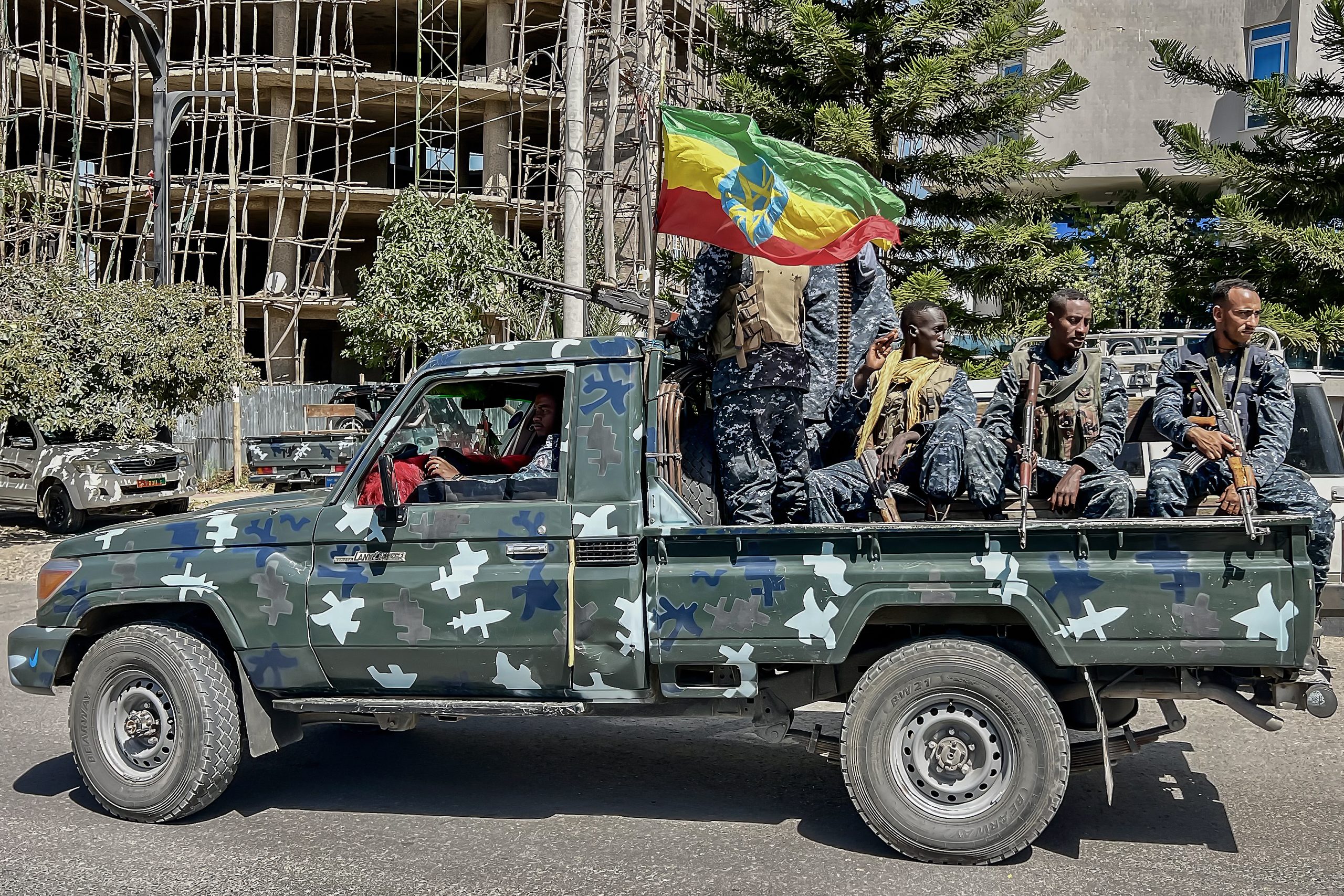
Ethiopian federal forces and their allies are closing in on a town near Eritrea’s border, a pro-government militia commander and a resident said Wednesday, raising fears of a regional war.
Ethiopia accuses Eritrea of backing the rebel Tigray People’s Liberation Front (TPLF), which launched a major offensive against government forces on September 23 before being pushed back and losing control of its strongholds.
A foreign security source has estimated that between 5,000 and 8,000 Eritrean forces were deployed in Ethiopian territory to support the rebels but were also forced into an apparent retreat.
A member of the pro-government militia told AFP that Eritrean soldiers present in the town of Zalambessa — near the border and a major battlefield during a previous 1998-2000 war between Ethiopia and Eritrea — had withdrawn.
“Villages near the town are held by the defence forces,” he said, speaking on condition of anonymity, adding: “No Ethiopian troops have crossed into Eritrea”.
“The Ethiopian army has arrived about five kilometres (around three miles) south of the town, while the Eritrean army is on its northern outskirts,” a Zalambessa resident told AFP, also requesting anonymity.
The “situation is causing deep concern among residents, who fear the town could become a battlefield”, he added.
Eritrean Information Minister Yermane Gebremeskel told AFP that rumours of Ethiopian troops crossing the border were “absolutely false”.
The Ethiopian army did not immediately respond to AFP requests for comment.
Earlier this month, the TPLF withdrew from the regional capital, Mekelle, without a fight.
Eritrean troops deployed to several locations in northern Tigray but were pushed back by drone strikes.
In recent days, pro-government forces have moved into key towns, such as Shire and Axum, near Eritrea’s border.
But TPLF vice president Amanuel Assefa told AFP that a military alliance — spanning multiple groups opposed to the federal government — “will succeed”.
He also warned the fighting could “evolve into a regional conflict”.
London-based think tank Chatham House said that if the fighting continued, international inaction could result in a “dangerous regional escalation”.
Eritrea gained independence from Ethiopia in 1993.
Following the 1998-2000 border war they briefly mended relations when Prime Minister Abiy Ahmed came to power, but have again fallen out, severing relations this month over the Tigrayan conflict.
Eritrea accuses landlocked Ethiopia of planning to use the conflict as a justification to invade its territory and seize control of Assab port on the Red Sea.
dyg/rbu/kjm