
By Samuel Ssenono
Commercial aviation across parts of the Middle East has been thrown into disruption, with civilian aircraft disappearing from the skies over Iran and Iraq and several major airlines suspending operations.
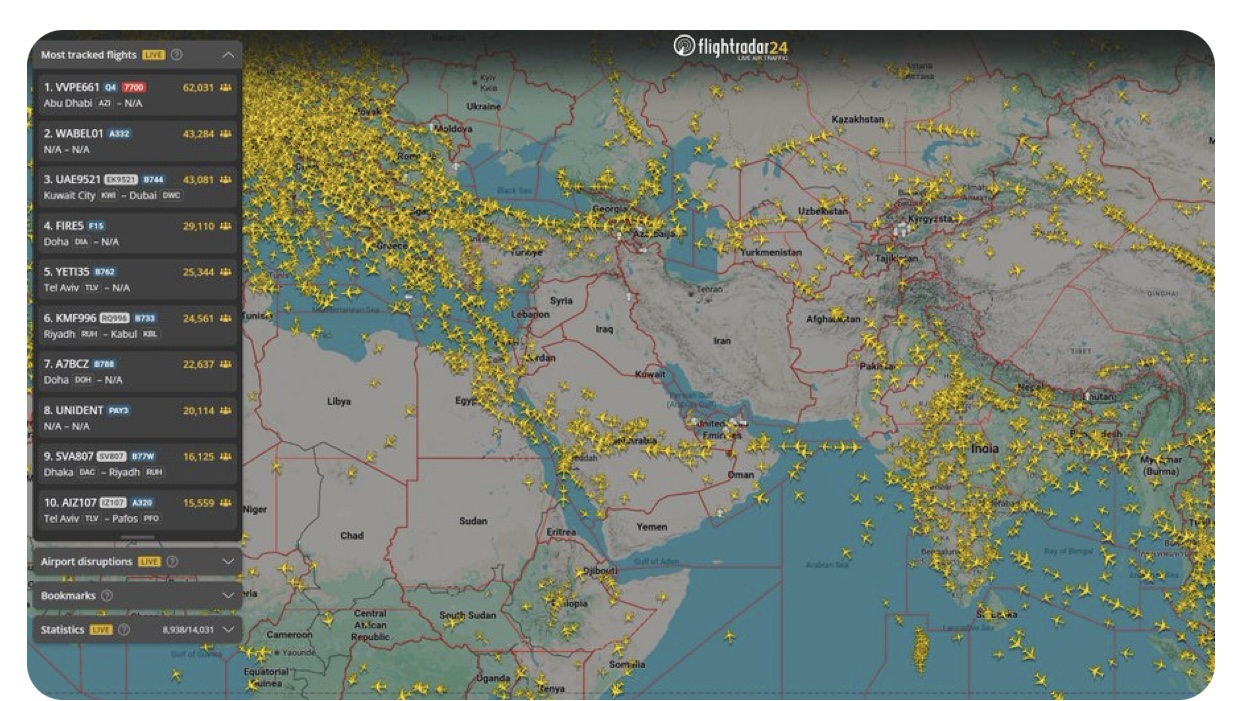
Live tracking data shows that airspace over Iran, Iraq, Kuwait, Bahrain and Qatar was closed as of 09:55 UTC. In a further development, flight monitoring indicated that no aircraft had taken off from Dubai International Airport for more than 30 minutes, and no arrivals had landed for over 10 minutes, an unusual pause for one of the world’s busiest hubs.
The ripple effects were immediate.
Emirates announced a temporary suspension of operations to and from Dubai, citing multiple regional airspace closures. The airline urged customers to check travel updates and flight status before heading to the airport, adding that it is assisting affected passengers with rebooking and refunds.
Qatar Airways confirmed it had temporarily suspended flights to and from Doha due to the closure of Qatari airspace. The airline said it is working with authorities and will resume operations once the airspace reopens, warning that delays are expected even after services restart.
Ethiopian Airlines also cancelled several Middle East services, including flights to Amman, Tel Aviv, Dammam and Beirut, as it monitors the security situation.
The region normally serves as a key transit corridor linking Europe, Africa and Asia. On a typical day, hundreds of long-haul aircraft cross Iranian and Iraqi airspace, connecting major global hubs.
Flight tracking platform Flightradar24 reported a surge in visitor numbers as users sought real-time updates, briefly causing some to encounter error messages due to increased demand.
For airlines, the closures mean rerouting aircraft north over Central Asia or south via Saudi Arabia and the Arabian Sea. These diversions add flight time, increase fuel burn and place additional pressure on crew scheduling and network planning.