By Nasir Lubwama
Uganda has registered a sharp rise in the number of learners sitting national examinations, with the latest results showing improvements in several key subjects even as educators warn about persistent weaknesses in analytical and practical skills among candidates.
Data released by the Uganda National Examinations Board (UNEB) indicates that both the Uganda Certificate of Education (UCE) and Uganda Advanced Certificate of Education (UACE) examinations recorded significant increases in candidature in 2025, reflecting growing demand for secondary education across the country.
Sharp Rise in Candidates at Both Levels
At the Advanced Level, a total of 166,400 candidates registered for the 2025 UACE examination, compared to 141,996 in 2024, representing an increase of more than 24,000 learners or 17.2 percent. Of those registered, 165,172 candidates sat the examinations, with absenteeism falling to 0.7 percent, one of the lowest rates in recent years.
Female candidates accounted for 43.7 percent of the total candidature, while males made up 56.3 percent, continuing a long-standing trend in which fewer girls proceed to Advanced Level studies.
At Ordinary Level, the numbers were even more dramatic. 432,163 candidates registered for the 2025 UCE examinations, up from 359,417 in 2024, an increase of 72,746 candidates or 20.2 percent.
More than 99.5 percent of the registered candidates sat the examinations, with absenteeism falling to 0.5 percent, suggesting stronger school participation and improved examination management across the country.

Majority of UACE Candidates Qualify for Higher Education
The UACE results show that the vast majority of candidates qualified for certification and further studies.
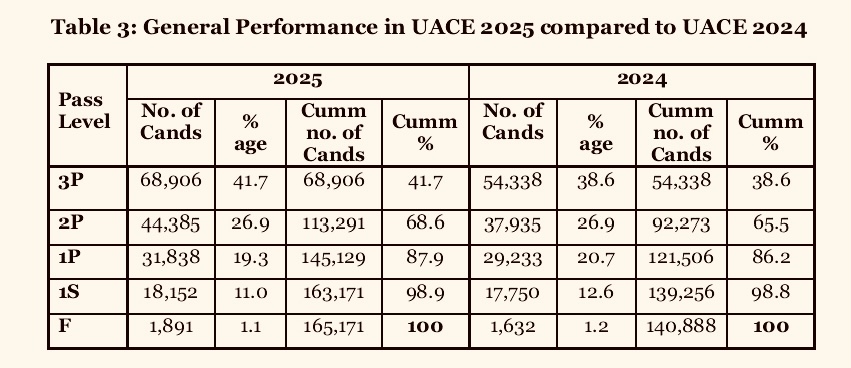
A total of 98.9 percent of candidates obtained the minimum requirement for the UACE certificate, while 68.6 percent achieved at least two principal passes, the traditional benchmark for admission to degree programmes in universities.
If universities maintain the two-principal-pass requirement, the country could see over 113,000 candidates eligible for university admission, compared to 92,273 candidates in 2024.
In addition, nearly 88 percent of candidates obtained at least one principal pass and two subsidiary passes, making them eligible for diploma-level programmes in technical and vocational institutions.
Education planners say the increase in qualifying candidates will place additional pressure on universities and tertiary institutions to expand capacity.
Female Candidates Continue to Perform Strongly
Although fewer girls sit the examinations at Advanced Level, the results show that female candidates continue to perform better proportionally in several areas.
In the 2025 UACE results, 44.6 percent of female candidates achieved three principal passes, compared to 39.5 percent of male candidates. Female candidates also recorded lower failure rates.
Education analysts say this trend has been consistent in recent years, highlighting the growing academic competitiveness of girls who remain in school through the Advanced Level cycle.
Stronger Performance in Sciences and Mathematics
UNEB reports notable improvements in several science subjects and mathematics.
Performance improved in Mathematics, Chemistry, Agriculture, Geography and Economics, while Biology and Literature in English also recorded gains.
Entries for mathematics and science subjects have also increased steadily. In 2025 alone:
- 70,132 candidates sat Mathematics
- 37,134 sat Chemistry
- 35,660 sat Biology
These figures represent steady growth compared to earlier years and signal rising interest in science-based fields among learners.
However, the number of candidates taking Physics remains relatively lower, especially among female students.
Curriculum Reform Reflected in UCE Results
The 2025 UCE examinations were conducted under Uganda’s Competency-Based Curriculum, which emphasizes practical application of knowledge and problem-solving rather than rote memorization.
Results show that 99.69 percent of candidates qualified for the UCE certificate, a significant improvement compared to the 98.1 percent recorded in 2024.
Under the new grading system, candidates are assessed using achievement levels ranging from A (Exceptional) to E (Elementary), with grades determined through a combination of continuous assessment (20 percent) and final examinations (80 percent).
In most subjects, the largest number of learners achieved Grade C, indicating a satisfactory level of competency.
Persistent Weaknesses in Critical Thinking
Despite improvements in overall performance, examiners have raised concerns about the ability of candidates to analyze questions and apply knowledge in practical situations.
In humanities subjects such as History, examiners observed weak analytical skills and poor organization of arguments.
In Geography, candidates struggled with interpreting data and linking theory to real-world environmental observations.
Similar challenges were reported in science practical assessments, where some learners found it difficult to interpret experimental scenarios or relate results to everyday situations.
Education officials say these gaps suggest that schools must do more to train learners in critical thinking and problem solving, which are central to the new curriculum.
Inclusion Expands for Special Groups
The examination board also reported progress in expanding access to education for special groups.
At UACE level, 540 candidates with special learning needs registered for the examinations, including those with visual impairments, hearing disabilities and physical challenges.
Prison education programmes also continued to produce candidates. At Luzira Upper Prison School, 68 inmates sat the UACE examinations, with the majority qualifying for certificates.
Growing Pressure on Education System
With candidate numbers rising rapidly at both O-Level and A-Level, education planners say Uganda’s higher education system will need to expand capacity to absorb the growing number of qualified students.
Universities, technical institutes and vocational training centres are expected to play an increasingly important role in accommodating the expanding pool of secondary school graduates.
At the same time, educators say improving teaching methods, analytical skills and practical learning will remain key priorities as the country continues to reform its education system.