
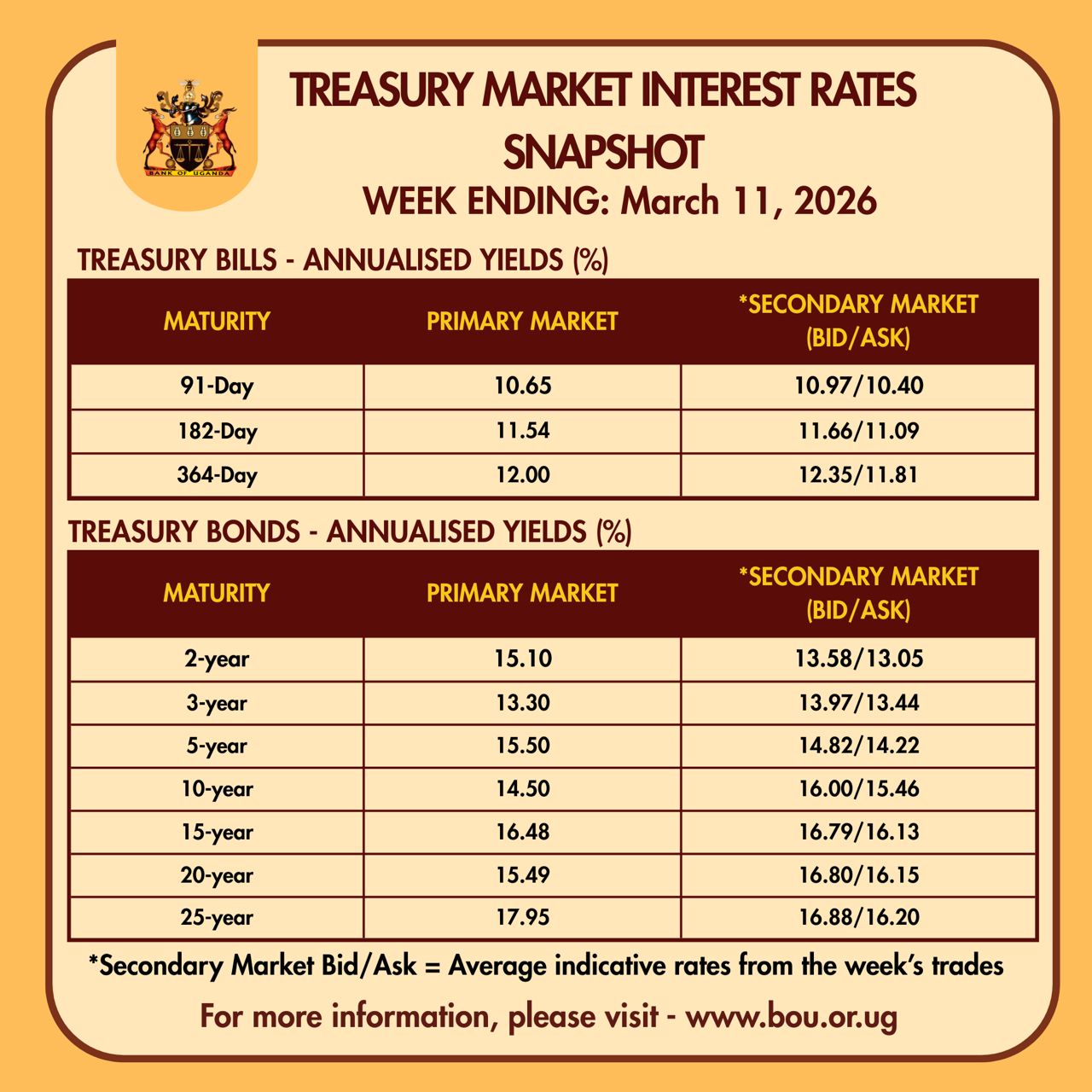
Yields on government securities remained steady in the week ending March 11, 2026, with longer-term bonds continuing to offer the strongest returns, according to the Bank of Uganda.
In the Treasury bills segment, the 91-day paper closed at 10.65 percent, the 182-day at 11.54 percent, and the 364-day at 12.00 percent.
Breaking it down
Treasury bills are short-term. They are popular with investors who want to keep their money safe but still earn something while they wait.
For example, if you invest UGX 10 million in a 91-day bill, you earn about UGX 266,000 in three months. If you go for the 364-day option, you earn about UGX 1.2 million over a year.
These are commonly used by businesses or individuals who may need their money back soon.
Bonds offer bigger returns
On the other hand, treasury bonds are long-term and pay more.
The 2-year bond stood at 15.10 percent, while the 5-year was at 15.50 percent. The 10-year bond came in at 14.50 percent.
The highest returns were on longer tenors. The 15-year bond was at 16.48 percent, while the 25-year bond peaked at 17.95 percent.
In simple terms, the longer you are willing to keep your money invested, the more you earn.
For instance, UGX 10 million invested in a 25-year bond can earn close to UGX 1.8 million a year.
What this tells us
The market is showing two things.
First, government securities remain one of the safest places to invest money in Uganda.
Second, investors are leaning toward long-term bonds because of the higher returns.
This is especially common among pension funds and insurance companies that are investing for the long haul.
The trade-off
There is a clear balance.
Short-term bills give you flexibility but lower returns
Long-term bonds lock your money for years but pay more
For many investors, the decision comes down to one question: how soon do you need your money back?
That choice is what continues to shape demand in Uganda’s treasury market.