
By Wadulo Arnold Mark
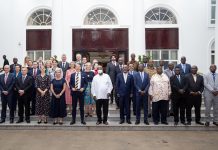
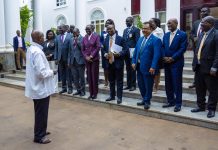
On May 11, 2026, under the watchful eyes of President Yoweri Museveni and President Félix Tshisekedi, a Memorandum of Understanding was signed between the Uganda Free Zones and Export Promotions Authority (UFZEPA) and the Democratic Republic of the Congo’s Agence Nationale de Promotion des Exportations (ANAPEX). This agreement, signed as part of the ninth session of the two countries’ Joint Standing Committee at statehouse Entebbe, marks a major pivot toward structured bilateralism, designed to move the needle from informal cross-border movement to a modernized, high-standard trade ecosystem.
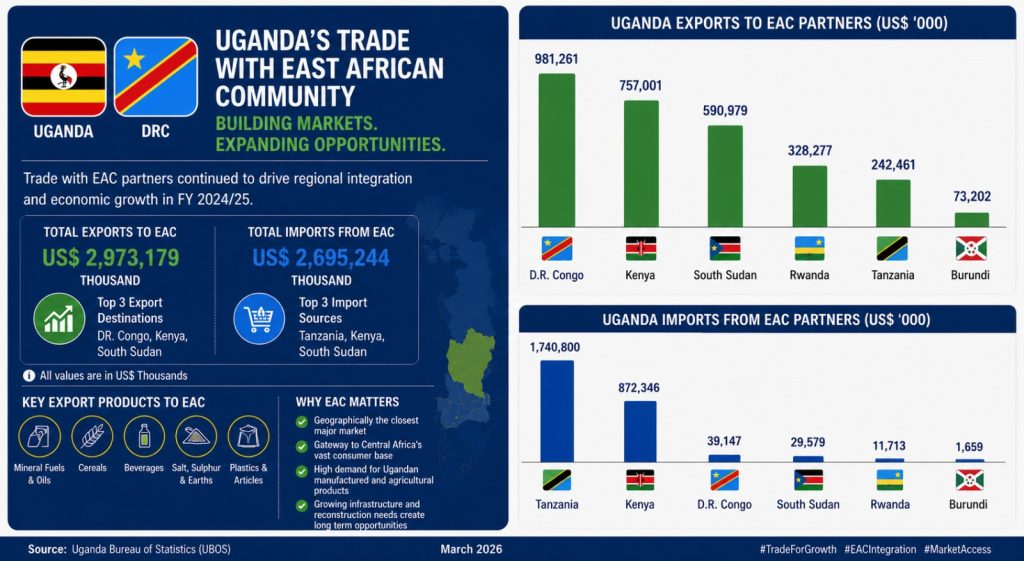
Hez Kimoomi Alinda, Executive Director of UFZEPA, in sequential interview with his counterpart said the DRC has emerged as Uganda’s leading trade partner, with total trade flows, combining formal and informal channels, now exceeding $1 billion. Uganda’s exports to its neighbor are diverse, ranging from milk and cooking oil to iron, cement and steel.
“Everything we are doing with this MOU is to help entrepreneurs of both countries trade better and prosper,” Alinda remarked. He pointed out that while trade within Africa currently constitutes only 16% of the continent’s total global trade, the Uganda-DRC corridor could be the catalyst for change. “If we can start with our own two countries and increase this trade… we can see trade between and among African countries growing… to probably 30% or 40%,” Alinda noted.
For Mike Tambwe Lubembwa, the Managing Director of ANAPEX, the MoU is a blueprint for organizational excellence. “This MoU we have signed with UFZEPA is to coordinate the commercial exchanges between the two countries and to do our best so that trade can have a clear orientation,” Lubembwa stated. He stressed that the goal is not just more trade, but better trade: “We want to ensure we can improve and develop the exchanges between Uganda and the DRC”.
The cooperation extends beyond policy into the physical reality of trade. Lubembwa highlighted that the agreement targets critical infrastructure gaps that have long hindered regional commerce. “There are articles that speak specifically to the creation of infrastructure, for example, warehouses to facilitate the transit of products coming from Uganda or the DRC so they do not spoil,” he explained, noting that joint financing will be sought to build these facilities. Furthermore, a heavy emphasis is placed on human capital: “We are going to train our producers and our agents so that we can work well together between the two countries”.
This regional alignment is bolstered by recent policy shifts, such as the mutual waiver of visa requirements and significant investments in road infrastructure in Eastern DRC to enable the movement of capital and people. The strategic importance of the Eastern DRC cannot be overstated, yet the reach is now national, with direct flights from Entebbe to Kinshasa facilitating the export of fresh produce like fish directly to the Atlantic coast.
While UFZEPA operates today as a unified powerhouse originating from the Uganda Export Promotions Board (est. 1996) and the Uganda Free Zones Authority (est. 2014), DRC’s ANAPEX is a younger entity, established only in 2020 and is explicitly looking to benchmark against Uganda’s long-standing institutional framework to accelerate its own export administration capabilities.
The Democratic Republic of the Congo’s (DRC) current enforcement of high import standards may still be considered relatively low, at around 20% or 30%. However, this presents an opportunity for both experienced and emerging Ugandan exporters to position themselves strategically, build early market trust, and establish strong trade relationships with the DRC.