By Sarah Mawerere
Mentioning FIFA in a malaria awareness is connecting the massive global reach of the World tournament to health advocacy where the passion for football is channeled into defeating malaria.
The “FIFA Malaria Championship” refers to public health advocacy initiatives such as; the United Against Malaria and current Zero Malaria FC campaigns, that use the global popularity of the FIFA World Cup to raise awareness, encourage prevention by sleeping under insecticide-treated mosquito nets, and urge leaders to eliminate the malaria.
This is done in partnership with health experts, governments, media, other civil society organizations and individuals of good.
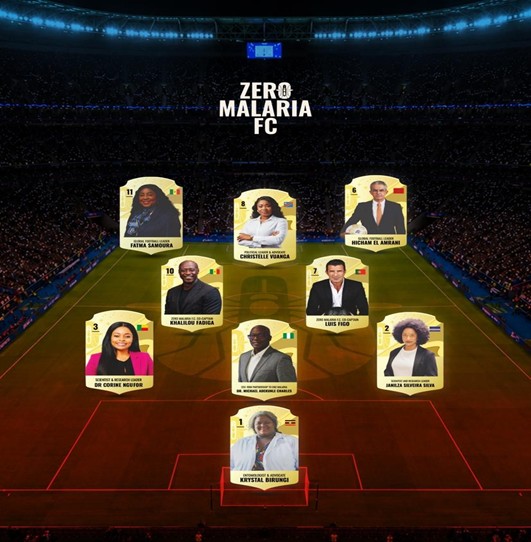
On World Malaria Day 2023, football legends Luís Figo and Khalilou Fadiga teamed up with Speak Up Africa and others to end malaria and announced an exciting new initiative.
The two senior footballers who are already champions of the “Zero Malaria F.C” initiative, supports the “Zero Malaria Starts with Me” campaign to end malaria.
The new initiative – part of the wider Zero Malaria Starts with Me campaign – will bring together a team of globally renowned footballers to increase malaria awareness, urge greater action against this deadly disease, and work with the RBM Partnership to advocate for the malaria response.
Over the coming months, Figo and Fadiga will be recruiting renowned men and women from the world of football to join this unique team and support the ambition to deliver a zero-malaria world. The full team will be announced later this year.
Key Messaging
- The Ultimate Match: Treat the parasite as the ultimate opponent that the global community can defeat through teamwork, strategy, and innovation, mirroring the discipline seen on the pitch.
- Call to Action: Use the tournament’s massive media footprint to urge policymakers and the international community to fund vital health tools and prevention programs.
Football has the power to bring people together around a common goal. Zero Malaria F.C. is an initiative bringing together globally renowned footballers, scientists, innovators and advocates behind one goal of Ending Malaria.
The Zero Malaria F.C supports the Zero Malaria Starts with Me campaign that aims to increase malaria awareness so to gain greater action against this deadly disease.
Uganda’s Krystal Birungi- champion for global Malaria elimination
Krystal Birungi is an Entomologist working at the Uganda Virus Research Institute. She is one of the global Malaria Champions who transforms childhood trauma into scientific innovation. Her journey started at the age of ten. Her young brother, five years old at the time, became very sick with malaria and began to have seizures with high temperature.
“We were the lucky ones because we survived in spite of suffering through these situations multiple times, many others did not make it”. “He survived and he is well today- I am 38 and he is 33”. Birungi said.
The memory of that night remains fresh up to today. She recalls watching her mother staying awake bringing the boy’s burning temperature down.
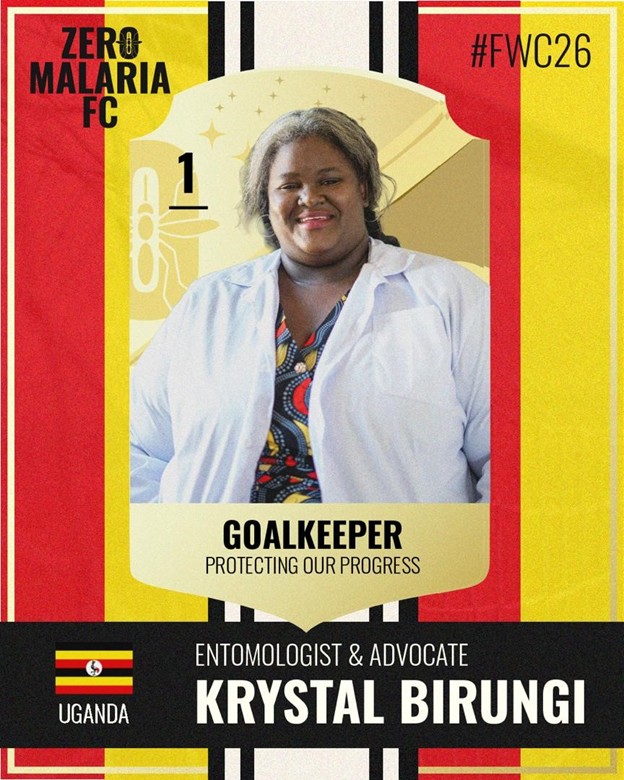
She channeled that childhood pain into professional action as an entomologist based at the Uganda Virus Research Institute in Entebbe.
A Global Voice for Change
Birungi relentless dedication has taken her to the global scene. She uses her platform to advocate for sustained health funding and equitable access through networks like the Global Fund.
There is no official sports tournament called a malaria championship hosted by FIFA. Instead, public health groups align their advocacy with the World Cup because the massive global audience provides a powerful platform to fight the disease
The incident that I am describing, he was 5 years old and I was 10. It is this incident that I would say really stuck in my mind, a memory that drove my determination to end malaria. However, it was not the only one. We all came down with malaria multiple times while growing up. Especially before the global fund was established. We are 3 children. I have 2 younger brothers
Speak Up Africa– an African-led organization based in Senegal, in collaboration with Luis Figo- former Portuguese international footballer, and Khalilou Fadiga- former Senegalese international footballer lead the campaign against malaria.
Based in Senegal, Speak Up Africa organization is dedicated to building an Africa where growth and sustainable development are driven by Africans themselves.
Speak Up Africa team works alongside leaders and change makers across Africa to advance effective policies and mobilize the resources needed to achieve the African Union’s Agenda 2063 and the Sustainable Development Goals (SDGs).
Founder and Executive Director, Speak Up Africa Yacine Djibo, noted that through Zero Malaria F.C, malaria can be eliminated. Adding, this however cannot be eliminated by one actor alone.
“We wanted to show that when governments, communities, health professionals, young people, the media, and content creators play on the same team, we can turn collective mobilization into lasting impact.” She said.
REMAPSEN (African Media Network for the Promotion of Health and Environment), is a continental network of African journalists. It also partners with organizations like Speak Up Africa to boost public health reporting, amplify advocacy campaigns, and spread vital awareness on disease prevention, including the fight against malaria and environmental protection.
Goals for Malaria Control and Elimination
At the World Health Assembly in May 2015, Member States adopted World Health Organization’s Global Technical Strategy for Malaria 2016–2030. The strategy is designed to guide and support all malaria-affected countries as they work to reduce the human suffering caused by the world’s deadliest mosquito-borne disease.
The African Union’s 2016 Catalytic Framework to End AIDS, TB and Eliminate Malaria in Africa by 2030, set elimination as the target, with zero malaria cases and deaths on the continent by 2030.
While disease incidence has decreased, the population in sub-Saharan Africa continues to grow at a rapid rate. More people are living in countries where malaria is a risk, putting further strain on health systems and national malaria program budgets.
Too many people are missing out on malaria interventions, the poorest and most marginalized in particular. Meanwhile, progress has been threatened by health emergencies, including epidemics, pandemics such as COVID-19, humanitarian crises and natural disasters.
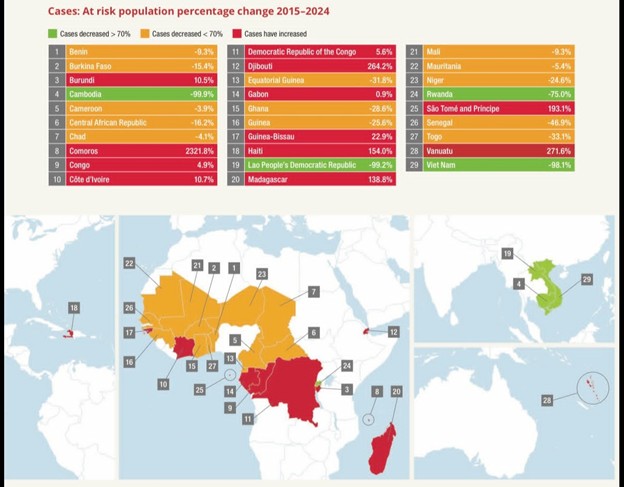
In Rwanda, for example, the 43.8% increase in malaria incidence seen in 2024 can be attributed to multiple factors. These include climatic variations such as rising temperatures, increased humidity and heavier rainfall, along with vector resistance to insecticides, and changes in mosquito biting behaviour that may reduce the effectiveness of existing control measures.
Furthermore, reduced coverage of integrated vector control interventions due to funding constraints may have contributed to the resurgence, particularly in areas that previously received multiple vector control interventions. A decline in funding for malaria, and for global public health in general, compromises the delivery of good-quality services.
For Uganda, the Uganda Malaria Elimination Strategic Plan 2026–2030 is a national public health roadmap launched by the Ministry of Health – Uganda on April 23, 2026. It shifts the country’s focus from mere malaria control to full elimination, targeting zero malaria deaths and a 75 percent reduction in cases by the year 2030.
Aiming at;
Zero Deaths: Achieve absolute zero malaria deaths nationwide by 2030.
Case Reduction: Cut malaria cases by at least 75 percent, moving from 274 down to fewer than 100 cases per 1,000 people.
Prevention Expansion: Scale up access to core protective tools like insecticide-treated nets and indoor residual spraying alongside new malaria vaccine research integration.
Director Public Health Uganda’s Ministry of Health Dr. Daniel Kyabayinze, explained that Uganda is currently carrying out the Indoor Residual targeting interventions by prioritizing high-burden ecological zones with high vector for vector and parasite management.
The Uganda high-burden malaria sub-regions and districts go across the Eastern, Northern, andWest Nile regions, such as the Bukedi, Busoga, and West Nile sub-regions (including districts like Tororo, Bugiri, Yumbe, and Gulu).
Dr. Kyabayinze further said expanding access to preventive tools such as insecticide-treated nets and treatment of malaria patients.
In A big push Against Malaria in the Francophone World report, it is indicated that the malaria burden in this world is a huge burden too.
Minister for Health of Benin Prof. Benjamin Hounkpatin was quoted in the report to have said that Francophone will feel the force of the perfect storm more than elsewhere. He further said 13% of the global population lives in francophone countries, but more than 40% of malaria cases and deaths occur in their family of nations.
He called upon the international community to work together and seize the opportunity of the 20th Francophone Summit to adopt an ambitious resolution to combat malaria across the francophone world.
Defeating malaria requires ultimate global teamwork, combining strong political leadership, community action, and shared funding. Just like the Zero Malaria F.C. squad uniting the world through sport, the international community must play as one team to beat this disease for good.