By Sarah Mawerere
As Uganda and the Democratic Republic of Congo (DRC) continue confronting a rapidly evolving Ebola outbreak, global health authorities view the current outbreak as a serious threat, involving a rare Bundibugyo Ebola Strain, which currently lacks licensed vaccines or therapeutics.
The world is heavily prioritizing community engagement, early detection, and infection control to contain it.
The World Health Organization declared the outbreak a Public Health Emergency of International Concern on 16 May, while the Africa Centres for Disease Control and Prevention designated it a Public Health Emergency of Continental Security.
It therefore activated to mobilize African leaders, governments, and international resources to coordinate a rapid, continent-wide response to severe disease outbreaks.
Kenya’s Ministry of Health has activated enhanced surveillance, constituted a National Ebola Preparedness Team, and has so far screened more than 34,500 travelers at airports, seaports, and land borders.
Isolation centres are on standby and KEMRI laboratories in Kisumu and Nairobi have been made ready for rapid testing .And the public is told to also access Ebola information by dialing *719# or calling 719.
Health Cabinet Secretary Aden Duale, confirmed- no cases have been recorded but warned of a risk due to regional connectivity. Bundibugyo strain, with no approved vaccines or therapeutics, has so far killed seven people in Uganda and a dozen of them in DRC.
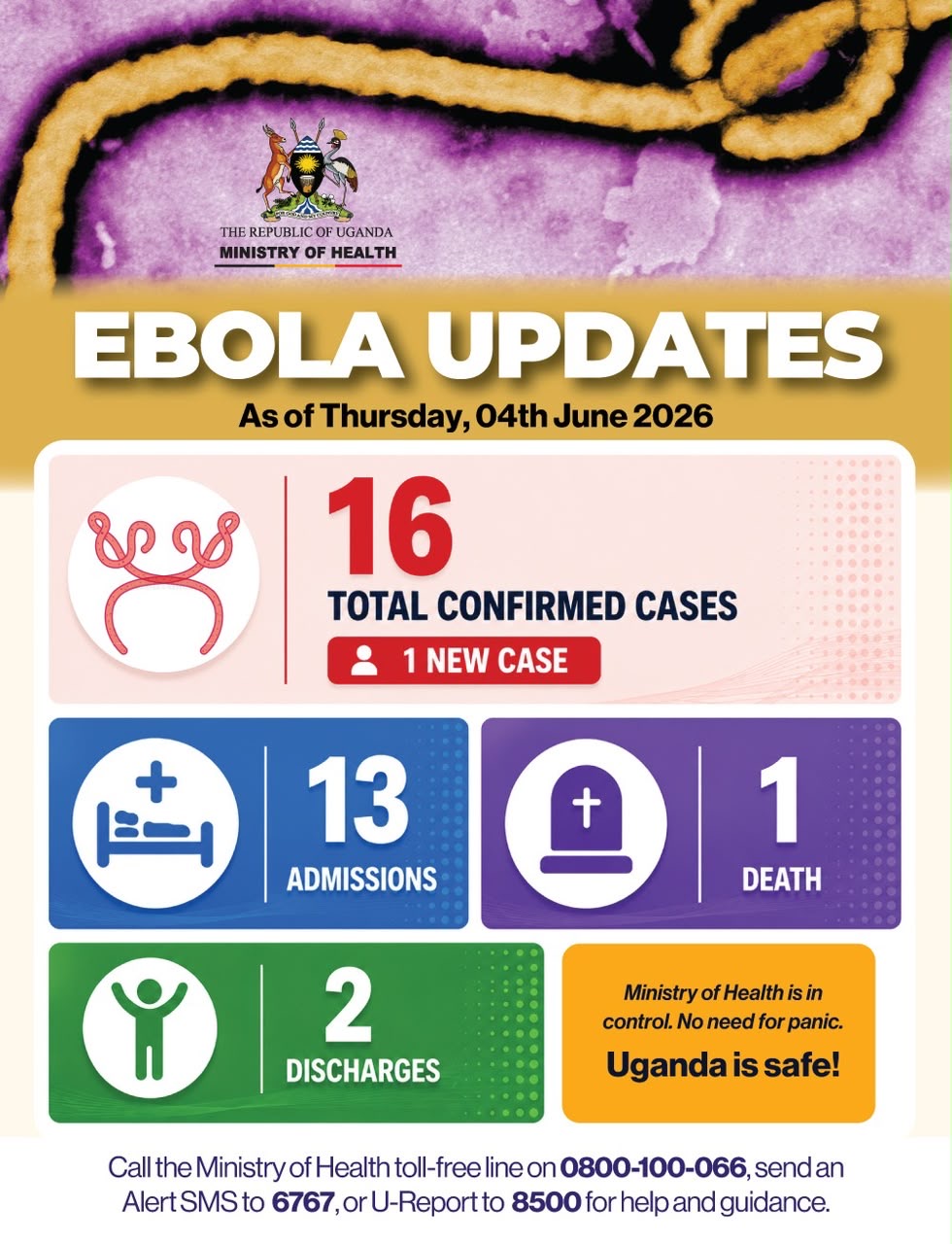
Uganda’s Minister for Health designate, Dr. Chris Baryomunsi confirmed that Uganda is battling an outbreak of the rare Bundibugyo strain of Ebola, with confirmed cases reaching 16. He stressed that because this specific strain currently lacks a vaccine, prevention and localized containment are the primary strategies.
The Ministry of Health – Uganda is actively tracing hundreds of contacts to break transmission chains.
Uganda and the Democratic Republic of Congo (DRC) have launched a joint health and security response to restrict unauthorized, high-risk movements across porous borders.
Dr. Baryomunsi has urged health authorities to rigorously supply frontline medical workers with the necessary Personal Protective Equipment (PPE) to safely manage suspected cases
Amid funding cuts from international partners, the Minister has called for stronger cross-border partnerships over isolated reactions or international travel bans.
The outbreak, centred in DRC marks over 17 times that Ebola outbreak has occurred since 1976.
AIDS Healthcare Foundation (AHF) has warned that the crisis highlights persistent weaknesses in the world’s ability to respond quickly and equitably to emerging infectious disease threats.
When Ebola crosses from DRC into Uganda, Kenya to check its preparedness plan. “We are 800 Kilometers from the epicenter.” Said Dr. Samuel Kinyanjui, AHF Kenya Country Director. “Every outbreak follows the same script: the virus moves fast, the international response moves slowly, and the communities closest to the danger are the last to receive the tools they need.
Kenya cannot afford another cycle of delayed action and fragmented cooperation. Preparedness must be built on equity and sustained investment — not on the assumption that the next outbreak will be someone else’s problem.” He further said.
AHF noted that Uganda and other African countries have repeatedly demonstrated strong leadership in outbreak detection, contact tracing, community mobilization and emergency response, often despite limited resources and immense logistical challenges.
Yet as countries confront another deadly outbreak, negotiations at the World Health Assembly failed to finalize the proposed Pathogen Access and Benefit Sharing (PABS) Annex to the WHO Pandemic Agreement — reportedly due to continued disagreements over equity and benefit-sharing obligations. The delay effectively places the broader Pandemic Agreement framework on hold at a moment when the need for international cooperation and clear accountability mechanisms is once again being tested in real time.
AHF emphasized that Ebola is once again exposing the consequences of a fragmented global health system — where frontline countries are expected to rapidly detect, report, and contain dangerous pathogens while negotiations over equitable access to diagnostics, treatments, vaccines, technology transfer, and financing remain unresolved.
AHF has supported awareness and response efforts against Ebola in Uganda and Sierra Leone in collaboration with national partners and lost a doctor to Ebola during the 2014–2016 West Africa outbreak. As governments continue debating equity provisions in Geneva, the outbreak serves as a real-world reminder that global health security cannot function without trust, cooperation, and enforceable commitments that apply to all countries equally.
AIDS Healthcare Foundation (AHF) is the world’s largest HIV/AIDS healthcare organization, providing cutting-edge medicine and advocacy to more than 3 million people across 50 countries, including in Africa, the United States, Latin America/Caribbean, the Asia/Pacific Region, and Eastern Europe.
How Ebola spreads:
People and animals, including primates, can become infected with a virus that causes Ebola disease from an animal that carries it.
People can also get Ebola disease through contact with the body fluids of an infected person or contaminated objects.
Even after someone recovers from Ebola disease, the virus can remain in areas of the body that are shielded from the immune system.
Ebola does NOT spread the same way as respiratory viruses like flu and COVID. You cannot get it from being near someone.
To prevent Ebola infection, strictly avoid direct contact with the blood, body fluids, and tissues of sick or deceased individuals, and refrain from handling or consuming wild animal meat (“bushmeat”). Ebola spreads through direct contact with contaminated fluids, not through the air.
Practice Hand Hygiene: Wash hands frequently with soap and clean water, or use an alcohol-based hand sanitizer (at least 70% alcohol).
Safe Funerals: Do not touch the body of a person who has died of a suspected or confirmed Ebola infection.
Ensure funerals are handled immediately by trained Ministry of Health burial teams.
Avoid Unprotected Sex: Avoid all sexual contact with recovered patients until testing confirms the virus is no longer present in their semen.
Avoid Wild Animals: Do not hunt, butcher, or eat raw meat from bats, monkeys, chimpanzees, or forest antelopes